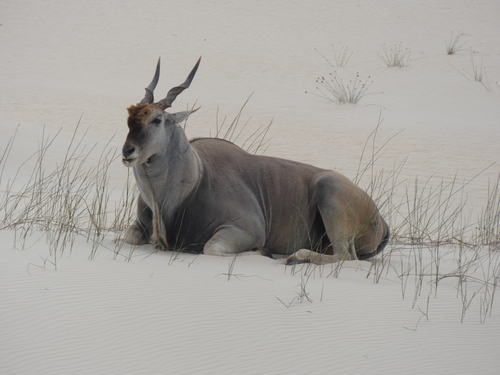
The largest antelope on the planet, the Common Eland can exceed the weight of a horse, yet it moves with an elegance that seems at odds with its size. It has a curious auditory characteristic. When walking, its knees produce an audible click, caused by the tendons and carpal bones. Field experts use this sound to detect the Common Eland even before seeing it among the vegetation. Despite its bulk,
The largest of the antelopes, the Common Eland has a robust grey-brown body which lightens with age. It has fine white vertical stripes on the flanks (sometimes barely visible in adults), a large, pendulous dewlap, and long spiral horns in both sexes. It differs from the Kudu, with which it shares habitat, by its much more massive body and straight, tightly spiralled horns.
Large cloven track, 8-10 cm long, with hooves more rounded than those of the Kudu. Droppings in oval pellets 1.5-2 cm long, sometimes somewhat clumped, left scattered when walking. An audible clicking of the knees when walking, produced by tendons and carpal bones, is a distinctive feature useful for detecting the Common Eland without seeing it.
Wooded savanna, scrubland and highland grassland, from lowlands to mountainous areas above 3000 m in parts of East Africa. Its distribution is fragmented across Southern and East Africa.
Mixed browser and grazer, feeding on leaves, shoots, fruits and grass depending on seasonal availability; it can go for long periods without drinking water.
The Common Eland is gregarious, forming herds of variable composition without fixed territories. Males establish dominance hierarchies rather than defended territories. Some East African populations move following the availability of grass and water.
Populations remain stable or are increasing in numerous reserves and hunting estates in southern and eastern Africa, with widespread captive breeding in South Africa.
Habitat loss due to agricultural and livestock expansion, competition with domestic livestock, and poaching localised outside protected areas.
See all species accounts for even-toed ungulates · Full species index
Mammaling is a free app for logging the mammals you find. You record a sighting in a moment — even if it's just a track — your life list grows, and the record becomes available to scientific and conservation projects.
It runs on your phone with nothing to install. If you like, it adds to your home screen like any other app.
Open Mammaling