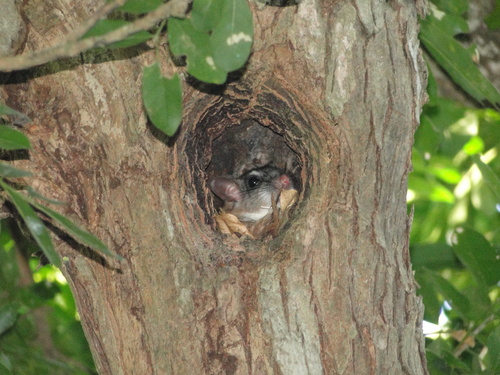
The Magdalena Woodrat is an arboreal rodent so rarely recorded that for decades it was considered one of the least known Mexican mammals, with very few specimens captured since its description in the late 19th century. It lives in the dry tropical forest of a strip of western Mexico, sheltering in tree hollows and moving through the dense vegetation of the lower canopy with the aid of a long tail. Its name honours the same American naturalist who named numerous species of small Mexican mammals documented in the early 20th century. It is the only known representative of its genus, an evolutionary lineage with no close relatives among other Mesoamerican rodents.
The Magdalena Woodrat is a medium-sized rodent with greyish-brown fur, large eyes adapted for nocturnal activity, well-developed ears, and a long tail. It differs from other arboreal rodents in the region as it is the sole representative of its genus, with no close relatives that it could be directly confused with. However, field identification often requires capture due to its rarity.
Track with 4 front toes and 5 hind toes, the hind track 2-2.5 cm long. Elongated droppings, 6-8 mm long, left scattered in the dense vegetation of the dry tropical forest understorey. It shelters in tree hollows, with occasional accumulations of gnawed plant remains next to the shelter entrance.
Dry tropical forest in lowlands, with trees offering hollows for shelter. Occurs along a strip of western Mexico, in the states of Jalisco, Colima and Michoacán.
It is omnivorous, feeding on leaves, fruits, and seeds from the dry tropical forest it inhabits.
The Magdalena Woodrat is arboreal, sheltering in tree hollows during the day and emerging at night to feed in the dense understorey vegetation. Its social and reproductive behaviour is little known due to the scarcity of studies on the species.
Its populations are considered to be in decline due to the continued loss of the dry tropical forest it depends on, increasingly transformed by agricultural and livestock expansion in western Mexico.
Deforestation and fragmentation of dry tropical forest due to agricultural and livestock expansion in western Mexico, and the loss of large trees with hollows available for shelter.
See all species accounts for rodents · Full species index
Mammaling is a free app for logging the mammals you find. You record a sighting in a moment — even if it's just a track — your life list grows, and the record becomes available to scientific and conservation projects.
It runs on your phone with nothing to install. If you like, it adds to your home screen like any other app.
Open Mammaling