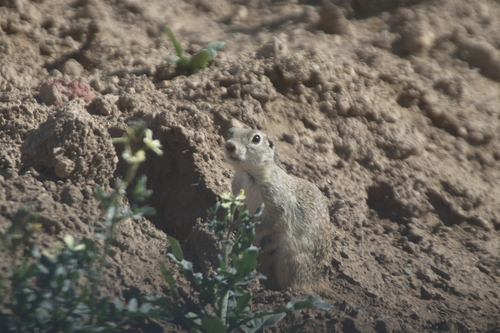
It lives in a single valley of height of the center of Mexico, the Oriental basin, divided between the states of Puebla, Veracruz and Tlaxcala, in an area so reduced that the whole world species falls within a strip of only 100 km long. It is a small terrestrial frog that excavates frogs in the semi-arid soil of that plateau valley, very different from the forest where most frogs are usually lived. Like the rest of terrestrial frogs, it enters a partial winter lethargy during the coldest months of the year, reducing its activity until the temperate spring temperatures return. Its distribution, restricted to a single valley intensely transformed by agriculture, makes it one of the species of Mexican rodent with the most available and fragmented habitat of all.
Small terrestrial frog, gray-colored brown fur, compact body and moderately long tail, with a pattern of clear spots little marked on the back. It differs from other terrestrial frogs of the Central Mexican region by its exclusive distribution to the Oriental Basin, without overlap with other species of its kind in that area.
Small footprint, 2.5-3 cm rear, with 5 rear fingers and 4 fronts. Small, lengthy feces, 6-8 mm, left scattered near the entrance of the strawberry. Excavate strawberries with an entry of 5-7 cm in diameter in open semi-arid soil, with removed ground mounds visible next to the entrance, often in rows following the edge of crops or xerophilic strawberries.
Matorral xerophile and semi-arid valley valley areas, generally between 2200 and 2700 m of altitude. endemic of the Oriental basin, distributed between the states of Puebla, Veracruz and Tlaxcala, in the center of Mexico.
Herbivorous and granivorous, he feeds on seeds, grass and dry fruit from the semi-arid vegetation of the valley where he lives.
It is diurnal and of terrestrial habits, with a reduced countryside territory around its swamp system. It enters a partial winter lethargy during the coldest months of the year, reducing its activity until spring.
Its habitat has been reduced and fragmented drastically by the conversion to land of cultivation in the Oriental Basin, with the species persisting today in just 16 locations known within an area already very restricted.
Conversion of the native xerophile mattress to cultivated land in the Oriental Basin, and the extreme fragmentation of the remaining populations into increasingly isolated patches.
See all species accounts for rodents · Full species index
Mammaling is a free app for logging the mammals you find. You record a sighting in a moment — even if it's just a track — your life list grows, and the record becomes available to scientific and conservation projects.
It runs on your phone with nothing to install. If you like, it adds to your home screen like any other app.
Open Mammaling