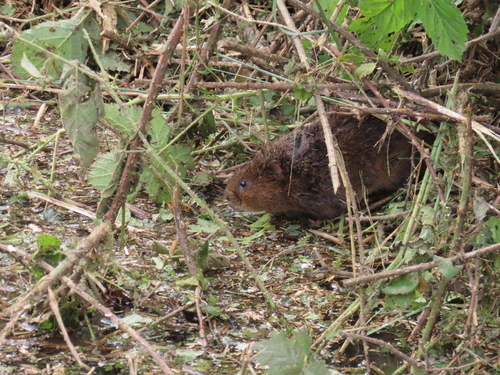
The Eurasian Water Vole is the largest of the European voles and one of the mammals with the most contradictory conservation history on the continent. Globally, it maintains numerous populations with little concern. However, in some regions where it was formerly more common, it has suffered one of the fastest declines documented in any European mammal. This almost always coincides with the arrival of an introduced predator capable of pursuing it into its own flooded burrow.
It excavates burrow systems next to water, with entrances both above and below the surface. Its habit of cutting aquatic vegetation stems into clean, regular pieces leaves one of the easiest tracks and signs to identify of all riparian fauna.
A medium-sized rodent, larger and more robust than a Common Vole. Its fur is dark brown to almost black. It has a stocky body, small ears almost hidden in the fur, and a relatively short, hairy tail. It lacks the sparse hair and paddle-shaped tail of the Muskrat, which is absent from Western Europe. It differs from the Brown Rat, with which it may share riverbanks, by its blunt, short snout, much smaller ears, and a proportionally shorter, hairier tail.
Track with 4 fore toes and 5 hind toes, the hind track 3-3.5 cm long, left on fine mud along the water's edge. Cylindrical droppings, 0.8-1.2 cm long, with blunt ends, deposited in small piles on stones or raised areas of the bank as a latrine. This differs from the Brown Rat, which does not usually concentrate its droppings so neatly. The most characteristic signs of its presence are stems of aquatic vegetation cut at a clean 45-degree angle and of regular length, left piled next to the burrow entrance. Also characteristic are the gallery entrances themselves, 5-7 cm in diameter, some just above water level and others submerged.
Banks of slow-flowing rivers, streams, canals and wetlands with dense riparian vegetation, from lowlands to mid-mountain areas.
Distributed across much of Europe and western Asia, with population trends varying greatly by region: stable or abundant in much of the continent, but in sharp decline in several areas of western Europe.
Herbivorous, it feeds on herbaceous and aquatic riparian vegetation, cutting stems into clean, regular pieces which it often leaves piled near the burrow before consuming them.
It lives in family colonies with a system of burrows next to water. It is active both day and night, depending on the region and predation pressure. The Eurasian Water Vole is an excellent swimmer and diver. Its strong dependence on riparian vegetation makes it very sensitive to alteration of the banks where it lives.
Globally, the Eurasian Water Vole remains numerous and faces no significant conservation problems. But in several areas of Western Europe, it has undergone a very rapid and well-documented decline since the introduction of the American Mink. This predator is capable of pursuing it in water and into its own burrows, with confirmed local extinctions in some river basins.
Predation by the introduced American Mink in areas where it has become established, canalisation and loss of natural riparian vegetation, and pollution of the watercourses on which the Eurasian Water Vole depends.
See all species accounts for rodents · Full species index
Mammaling is a free app for logging the mammals you find. You record a sighting in a moment — even if it's just a track — your life list grows, and the record becomes available to scientific and conservation projects.
It runs on your phone with nothing to install. If you like, it adds to your home screen like any other app.
Open Mammaling