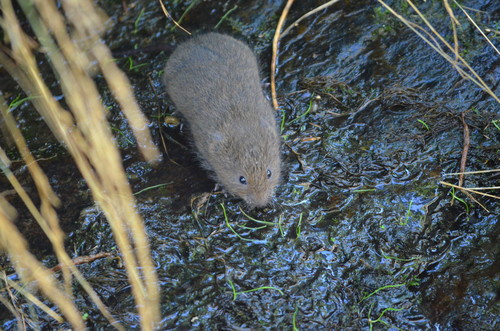
Despite its name in several languages, the Southwestern Water Vole has no kinship with true rats. It is a semi-aquatic rodent of the vole family, so tied to water that it rarely strays more than a few metres from a river, stream or irrigation ditch.
The Southwestern Water Vole is one of the best indicators of water quality in low and mid-altitude watercourses in southwestern Europe. Its disappearance from stretches where it was once common has been used as an early warning sign about the state of those ecosystems.
In some areas, the Southwestern Water Vole has suffered such a marked decline that it is now difficult to find in rivers where it was common just a few decades ago.
A medium-large rodent for a vole, much larger than terrestrial voles, with dark brown to blackish fur and a thick, hairy tail about half the body length. It is often confused with the Brown Rat. However, it differs by its blunter snout, smaller ears hidden in the fur, and a hairy tail instead of a naked, scaly one.
Track with 4 fore toes and 5 hind toes, 3-4 cm long, often showing partial webbing marks in soft substrate next to water. Cylindrical droppings, 1-1.5 cm long, with blunt ends and abundant plant fibre, deposited in small piles on stones or vegetation along the bank as territorial markers. The Southwestern Water Vole leaves visible burrow entrances just above or below water level on banks, and remains of aquatic plant stems cut at a clean angle next to characteristic feeding stations by the water.
Banks of rivers, streams, ditches, and wetlands with clean, slow to moderate flowing water, from lowlands to mid-mountain areas. Distributed throughout the Iberian Peninsula and southwestern France, with a much smaller range than other European semi-aquatic rodents.
Herbivorous, the Southwestern Water Vole feeds on aquatic and riparian vegetation (rushes, grasses, tender bark). It cuts and consumes this by the water at fixed, recognisable feeding stations.
The Southwestern Water Vole is territorial and mainly solitary outside the breeding season. It defends a linear territory along the bank from other individuals of its own species.
It digs burrows in the banks with underwater entrances. In populations from warmer areas, it can have several litters per year.
The Southwestern Water Vole has experienced a significant contraction of its home range in several regions of western Europe since the late 20th century. Local disappearances are documented in stretches of river where it was formerly common. However, trends vary greatly by catchment, and stable population strongholds persist in several areas.
Degradation and pollution of watercourses, competition and predation by the introduced American Mink, channelisation and loss of riparian vegetation, and bycatch in traps set to control other rodent species considered pests.
See all species accounts for rodents · Full species index
Mammaling is a free app for logging the mammals you find. You record a sighting in a moment — even if it's just a track — your life list grows, and the record becomes available to scientific and conservation projects.
It runs on your phone with nothing to install. If you like, it adds to your home screen like any other app.
Open Mammaling