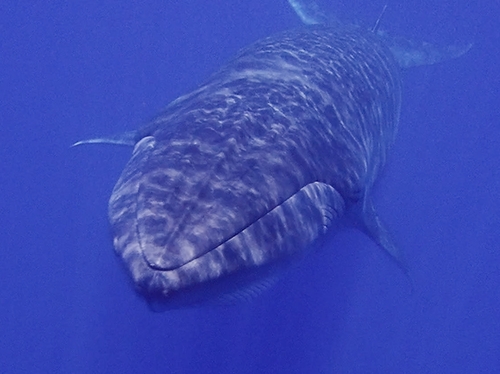
It is one of the big whales less known by the general public, partly because for decades its identity was confused with that of other very similar whales of the same genre, a taxonomic plot that science has not yet solved completely: some specialists consider it a species of its own, of oceanic distribution and a bigger size, while others include it as a simple form within the Bryde whale in broad sense. It lives in temperate and tropical waters around the world, and unlike most large whales does not usually undertake long seasonal migrations, remaining in relatively warm waters throughout the year. It is characterized by three parallel crests on the top of the head, a unique trait between the whales of its size that helps to differentiate it from other species related in the sea.
Big whale, thin body of dark gray color, with three parallel longitudinal crusts on the top of the head instead of the only central crust of most rorcuals. It differs from the common rorcual and the boreal rorcual, very similar at distance, precisely by those three cranial crusts, visible only with good observation of the head.
It does not leave traces by being a strictly marine cetacean; it is recognized by a high and narrow breath, and by a sequence of immersion with the back and a relatively large folded dorsal aleta visible almost at the same time when breathing.It is able to make sudden turns and direction changes on the surface while feeding, a more agile behavior than that of other large rorcuals of its size, and sometimes groups of marine birds are observed concentrated on their feeding zones as an indirect signal of their presence.
Temperate and tropical waters of the open sea and continental platform of all the oceans of the world.Distributed virtually globally between the 40° north and south latitude, without long seasonal migrations like those of other large whales.
It feeds on bank fish and krill, captured by fast wraps with the mouth open in areas of high concentration of prey.
Of habits generally solitary or in small loose groups, it does not carry out the large seasonal migrations typical of other barbe whales, remaining in warm waters throughout the year.
Its populations are generally considered stable on a global scale, although taxonomic uncertainty about what forms exactly this species includes makes it difficult to evaluate specific population trends for each one.
Collisions with vessels, wreckage in fishing gear, and marine acoustic pollution that can interfere with their communication and localization of prey.
See all species accounts for even-toed ungulates · Full species index
Mammaling is a free app for logging the mammals you find. You record a sighting in a moment — even if it's just a track — your life list grows, and the record becomes available to scientific and conservation projects.
It runs on your phone with nothing to install. If you like, it adds to your home screen like any other app.
Open Mammaling