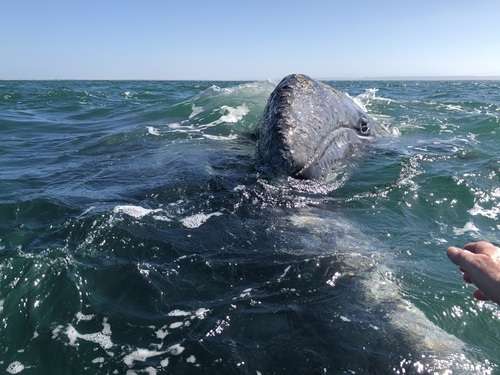
It travels the longest known migration among mammals, roughly 20,000 km back and forth each year between the Arctic waters where it is fed and the warm low-latitude lagoons where it pairs its breeds. Unlike the rest of large whales, it feeds by turning side by side on the sea floor and aspirating sediment with invertebrates, leaving behind authentic swamps in the ocean floor. It was on the brink of extinction twice by commercial hunting, and today the population of the Eastern Pacific is considered recovered while the population of the Western Pacific remains extremely reduced. In the breeding lagoons of Lower California, some females come spontaneously to boats, such an unusual behavior among large cetaceans that has given world fame to those lagoons.
Large-sized whale, no dorsal whip (only a low whip followed by a series of knots to the tail), gray motifed skin covered with whitening patches of percebes and whale lice. It differs from other large whales by that absence of dorsal whip and by its clearly motifed skin; the breath is low and heart-shaped seen from ahead or behind.
It does not leave footprints on the ground by being a strictly marine cetacean, but its presence is recognized by its low and bifid breath, visible as a heart-shaped cloud, and by the immersion sequence: several breaths followed on the surface before it arches its back and shows its tail when it submerges deeply. In its feeding zones it leaves lengthy pitches and clouds of sediment removed on the marine bottom, a unique trace among the large whales because it is the only one that feeds mainly by sucking the sea bed.
Somer coastal waters, from food zones in Arctic and sub-Arctic seas to warm breeding lagoons in low latitude.Distributed in the northern Pacific, with an eastern population migrating along the American coast and a much more reduced western population in the Asian Pacific.
It feeds mainly on amphibians and other small bentonic invertebrates, which it obtains by sucking sediment from the seabed and filtering it through its beards.
It carries out the longest known annual migration among mammals, between food zones in cold waters and breeding lagoons in warm and protected waters. The females leave a single breeding every one or two years in those underground lagoons, where they remain several weeks before starting the return journey. It is generally solitary or in small and unstable groups, except in seasonal concentration zones.
The population of the eastern Pacific has recovered strongly since the end of commercial hunting and is now considered relatively stable, while the population of the western Pacific remains very reduced and subject to specific follow-up.
Collisions with vessels, wreckage in fishing gear, and changes in the availability of prey in their Arctic feeding zones associated with climate change.
See all species accounts for even-toed ungulates · Full species index
Mammaling is a free app for logging the mammals you find. You record a sighting in a moment — even if it's just a track — your life list grows, and the record becomes available to scientific and conservation projects.
It runs on your phone with nothing to install. If you like, it adds to your home screen like any other app.
Open Mammaling