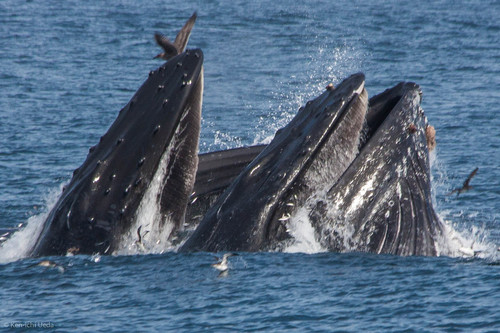
The Humpback Whale is known for its song: males produce complex, prolonged vocal compositions during the breeding season. These can propagate underwater for many kilometres, and change from one season to the next, like shared fashions across entire populations. Each year, it undertakes some of the longest known migrations among mammals, from polar waters where it feeds to tropical waters where it breeds. It is also a remarkable recovery story: following the end of large-scale commercial whaling, its populations have recovered strongly across most of the planet. However, a small, isolated group in the Arabian Sea, which does not even migrate, remains in a much more precarious situation.
The Humpback Whale is a large baleen whale with a robust, greyish-black body. Its belly colouring varies between white and black depending on the population. It has extremely long pectoral fins (up to one third of body length) with a scalloped edge. A characteristic hump is visible in front of the dorsal fin when it arches its back to dive. The underside of its caudal fin has a unique pattern of black and white spots, allowing for individual identification. It is distinguished from other large whales by its disproportionately long pectoral fins.
The Humpback Whale does not leave observable tracks or droppings in the field in the usual way. Instead, signs are based on surface behaviour: the blow, columns of vapour up to 3 m high visible from a distance, full breaches with a loud crash on re-entry, and the characteristic raising of the tail fluke just before a deep dive.
Males produce complex, prolonged songs during the breeding season. These are audible underwater for many kilometres and are used to study the species non-invasively.
The Humpback Whale inhabits all the world's oceans, from polar and subpolar waters in summer, where it feeds, to tropical and subtropical waters in winter, where it breeds. It undertakes one of the longest known migrations among mammals, several thousand kilometres each year. A notable exception is the Arabian Sea population, which remains year-round in tropical waters without undertaking this seasonal migration.
The Humpback Whale feeds on krill and small schooling fish. It catches these using cooperative feeding techniques, such as 'bubble-net feeding'. In this method, several individuals coordinate air bubbles to concentrate prey before lunging with open mouths.
It undertakes long annual migrations between cold-water feeding grounds and warm-water breeding grounds, where it feeds little for several months. Females give birth to a single young every 1-3 years after migrating to warm waters. Males compete for access to females through songs and physical disputes.
The Humpback Whale has recovered remarkably worldwide since the end of large-scale commercial hunting in the 20th century. Most populations have shown sustained growth in recent decades. However, some isolated, small populations, such as that in the Arabian Sea, remain in a much more delicate conservation status. This population does not migrate and is genetically isolated from the rest of the species, and has not shown similar improvements.
Collision with vessels, entanglement in fishing gear, acoustic pollution that interferes with communication, and, in the case of the Arabian Sea population, its small size and genetic isolation.
See all species accounts for even-toed ungulates · Full species index
Mammaling is a free app for logging the mammals you find. You record a sighting in a moment — even if it's just a track — your life list grows, and the record becomes available to scientific and conservation projects.
It runs on your phone with nothing to install. If you like, it adds to your home screen like any other app.
Open Mammaling