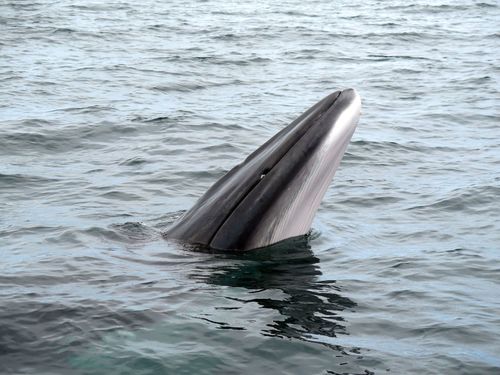
The Common Minke Whale is the smallest and most numerous of the great whales. It is also one of the few that can still be seen relatively easily from the coast in various parts of the world, making it a regular subject of whale-watching excursions. Its common name refers to its pointed, narrow snout, very different from other whales with wider, blunter snouts. Despite being the main target of commercial whaling that continues today in some countries, its global populations have remained comparatively numerous. This contrasts with the historical decline suffered by almost all other great cetaceans.
The Common Minke Whale is small for a rorqual. It has a slender dark grey body with a white belly and a pointed, narrow snout. Most Northern Hemisphere populations also show a characteristic white band on each pectoral fin. It differs from other rorquals, all of which are larger. This is precisely due to its smaller body size and that white pectoral band, which is absent in the Common Rorqual or the Boreal Rorqual.
It leaves no tracks on land. It is detected by a low, inconspicuous blow, barely perceptible in rough seas. This is followed by a rapid surfacing of its back and falcate dorsal fin; it does not show its tail when diving. It rarely leaps completely out of the water, unlike other more acrobatic rorquals. It may curiously approach stationary vessels, and underwater it emits series of low-frequency pulses used in long-distance communication.
Oceanic and coastal waters of all oceans, from tropical zones to the limits of polar ice in summer, with seasonal movements between feeding areas in high latitudes and breeding areas in warmer waters. It is the rorqual with the widest global distribution.
It feeds on small schooling fish and krill, captured by rapid lunges while filtering water through its baleen plates.
Generally solitary or in small, unstable groups, with seasonal migratory movements between feeding and wintering grounds. It is one of the rorquals with the most variable behaviour, with populations showing different migratory patterns depending on the region.
Its global populations remain numerous and generally stable, unlike the historical decline suffered by most large rorquals. However, it is still subject to commercial hunting in some countries and, in others, to scientific hunting that was questioned in the past.
Continued commercial hunting in some countries, bycatch in fishing gear, collision with vessels, and acoustic pollution that can interfere with its long-range communication.
See all species accounts for even-toed ungulates · Full species index
Mammaling is a free app for logging the mammals you find. You record a sighting in a moment — even if it's just a track — your life list grows, and the record becomes available to scientific and conservation projects.
It runs on your phone with nothing to install. If you like, it adds to your home screen like any other app.
Open Mammaling