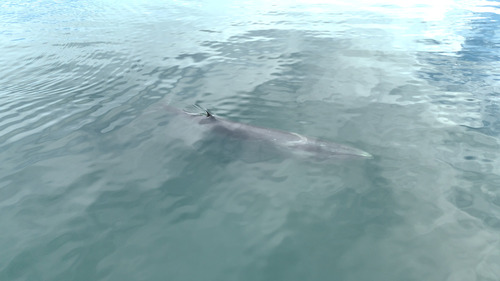
The Sei Whale is one of the fastest whales in the ocean, capable of reaching speeds of up to 50 km/h over short distances. This is exceptional for an animal weighing several tens of tonnes. Unlike other large whales, it rarely approaches coastal waters or raises its tail fluke when diving. This makes it one of the least studied and most difficult to observe closely. It was one of the most persecuted species by commercial whaling in the 20th century, precisely when populations of other larger whales had already collapsed. Its subsequent recovery, though real, has been much slower than that of other large whales.
A large whale, with a slender, dark grey body with lighter oval spots scattered along the flanks, a head with a single central longitudinal ridge, and a relatively tall, curved dorsal fin. It is confused with the Fin Whale, which is larger and lacks these oval spots, and with Bryde's Whale, which is very similar in appearance but has three ridges on its head instead of just one.
The Sei Whale does not leave tracks or droppings usually observable in the field. Signs are based on surface behaviour: a medium-height vertical blow, and the almost simultaneous appearance of the head and dorsal fin. It hardly arches its back, unlike other large whales. It rarely shows its caudal fin when beginning a dive, which makes its individual photographic identification very difficult compared to species such as the Sperm Whale or the Humpback Whale.
Temperate and subpolar oceanic waters of all the world's oceans, generally in open sea and far from the coast. Seasonal movements occur between high-latitude feeding grounds and warmer-water breeding grounds.
It feeds on krill, copepods and small schooling fish, filtering them by swimming through dense shoals of prey near the surface. Its feeding technique is more similar to that of Right Whales than to that of other rorquals.
The Sei Whale undertakes seasonal migrations between polar and subpolar feeding grounds and breeding grounds in temperate waters, though these are less predictable and less well known than those of other large whales. It usually travels in small groups of a few individuals, and females give birth to a single young every 2-3 years.
Commercial whaling in the 20th century drastically reduced Sei Whale populations worldwide. Although signs of recovery have been observed in several regions since the international moratorium, the pace has been much slower than for other large whales. Recent assessments recommend caution before downgrading its level of concern.
Collision with large vessels, entanglement in fishing gear, and possible displacement or alteration of its feeding grounds due to climate change, which affects the availability of krill and other planktonic prey.
See all species accounts for even-toed ungulates · Full species index
Mammaling is a free app for logging the mammals you find. You record a sighting in a moment — even if it's just a track — your life list grows, and the record becomes available to scientific and conservation projects.
It runs on your phone with nothing to install. If you like, it adds to your home screen like any other app.
Open Mammaling