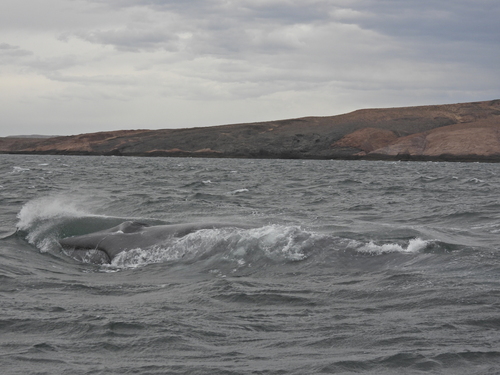
It is the largest animal ever to have existed on Earth, heavier than any known dinosaur, with a heart the size of a small car and a tongue that alone can weigh as much as an elephant. Despite its immense size, it feeds almost exclusively on one of the ocean's smallest animals, krill, of which it can swallow several tonnes a day during the feeding season. The Blue Whale was hunted to the brink of extinction during the 20th century. Although it is now slowly recovering in several regions, its global population remains a tiny fraction of what it was before industrial whaling.
The largest known whale, with an elongated bluish-grey body and characteristic mottling, a broad, flat, U-shaped head when viewed from above, and a very small dorsal fin set far back on the body. It differs from the Fin Whale by its more bluish and uniform colour and by lacking the colour asymmetry on the jaw characteristic of that species, and from the Humpback Whale by its much shorter pectoral fins.
It leaves no tracks on land. It is detected by an extraordinarily high vertical blow, up to 9-12 m high, visible several kilometres away in calm seas. Its presence is also revealed by the prolonged appearance of its back when breathing before a deep dive. It rarely shows its fluke when diving. Underwater, it produces some of the most powerful and lowest-frequency calls in the entire animal
All the world's oceans, from polar waters during feeding season to tropical and subtropical waters during breeding season, generally in open sea and often associated with areas of high krill productivity.
It feeds almost exclusively on krill, which it captures by lunging through dense shoals and filtering the water with its baleen plates. It can ingest several tonnes of prey per day during the feeding season.
It undertakes long annual migrations between polar and subpolar feeding grounds and warm-water breeding grounds, where it feeds little for several months. It usually travels alone or in pairs, and females give birth to a single young every 2-3 years after a prolonged gestation.
The global population was reduced by more than 90% due to commercial hunting in the 20th century. Some populations, such as those in the Northern Hemisphere, show clear signs of recovery since the international moratorium. However, the Antarctic subpopulation, the most decimated of all, remains in a much more critical conservation situation, and its recovery is much slower.
Collision with large vessels, entanglement in fishing gear, acoustic pollution that interferes with its long-distance communication, and possible changes in krill availability associated with climate change.
See all species accounts for even-toed ungulates · Full species index
Mammaling is a free app for logging the mammals you find. You record a sighting in a moment — even if it's just a track — your life list grows, and the record becomes available to scientific and conservation projects.
It runs on your phone with nothing to install. If you like, it adds to your home screen like any other app.
Open Mammaling