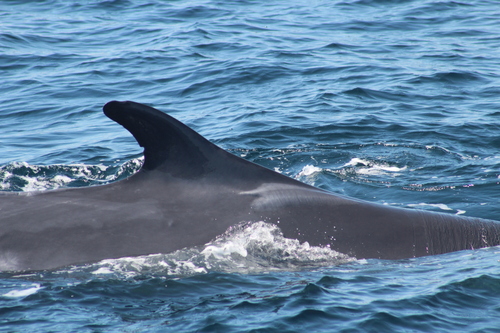
The Fin Whale is the second largest animal to have ever lived on the planet, surpassed only by the Blue Whale. It can reach speeds of over 40 km/h over short distances. This surprising agility for a body weighing several tens of tonnes has earned it the nickname 'greyhound of the seas'. It roams all the world's oceans, from polar waters to temperate and tropical zones, though it rarely approaches the coast as closely as other large whales. Decimated by commercial whaling in the 20th century, the Fin Whale is now one of the most cited examples of a large whale's recovery thanks to international protection. However, its story is not equally positive in all the seas where it lives.
The Fin Whale is a large whale with an elongated, slender body, dark grey with a white belly. It has a unique asymmetry among mammals: the lower jaw is white on the right side and dark on the left. It has a small, curved dorsal fin located far back on the body, visible shortly after the blow when it surfaces to breathe. It can be confused with the Blue Whale, which is larger
It does not leave observable tracks or droppings in the field in the usual way; signs are based on surface behaviour: a tall, narrow blow, up to 6 m high, visible from a great distance in calm seas, followed by the appearance of its elongated back and small dorsal fin. It rarely shows its tail fluke when diving, unlike other large whales, which makes individual photo-identification difficult. It can also be detected by its low-frequency vocalisations, some of the lowest in the animal kingdom, capable of travelling hundreds of kilometres underwater.
All the world's oceans, from Arctic and Antarctic waters during feeding seasons to temperate and subtropical waters in winter, generally in open sea and far from the coast. Some populations, such as the Mediterranean Sea population, remain year-round in a semi-enclosed basin instead of undertaking the large migrations typical of the species.
The Fin Whale feeds on krill, small schooling fish and other planktonic organisms, which it catches by lunging at high speed with its mouth open through dense shoals of prey.
It undertakes seasonal migrations between feeding grounds in cold waters and breeding grounds in warmer waters, although these are less pronounced and less understood than in other large whales. It usually travels in small, shifting groups, although it can form larger aggregations in highly productive feeding areas. Females give birth to a single young every 2-3 years after a long gestation.
The global population has approximately doubled since the 1970s, due to the international ban on commercial whaling in the North Pacific and Southern Hemisphere since 1976 and a sharp reduction in catches in the North Atlantic since 1990. However, the genetically isolated and much smaller Mediterranean Sea population does not show the same recovery and remains a specific concern.
Collisions with large vessels, especially in the Mediterranean where maritime traffic is very dense, entanglement in fishing gear, acoustic pollution and, in some areas, continued hunting outside international moratoria.
See all species accounts for even-toed ungulates · Full species index
Mammaling is a free app for logging the mammals you find. You record a sighting in a moment — even if it's just a track — your life list grows, and the record becomes available to scientific and conservation projects.
It runs on your phone with nothing to install. If you like, it adds to your home screen like any other app.
Open Mammaling