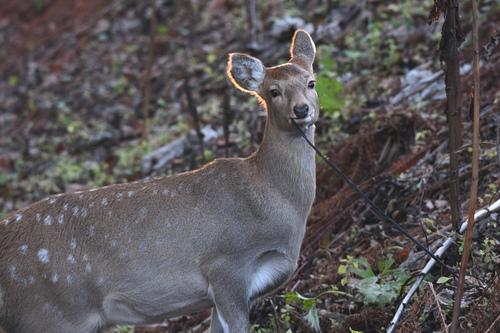
Native to Japan and East Asia, Sika Deer have also been established in Europe for over a century. They arrived as ornamental animals in parks and estates, subsequently escaping to form stable feral populations.
In many populations, they retain the white spots of their juvenile pelage into adulthood, which is unusual among medium-sized deer.
Where they overlap with European Red Deer, they can hybridise. This creates a genetic conservation problem that concerns wildlife managers in several countries.
A medium-sized deer, smaller than Red Deer. Its reddish-brown coat has white spots, which persist in adults in many populations and subspecies (especially in summer). It also has a white rump patch, bordered with black, which erects when alarmed. Only the male bears antlers, which are simpler than those of Red Deer. It can be confused with Fallow Deer, but the Sika Deer has a shorter tail and a characteristic black-bordered rump patch.
Cloven track, inverted heart-shaped, 4-6 cm long, smaller and narrower than a Red Deer's.
Cylindrical droppings, grouped in piles, 1.5-2 cm long.
During the rut, males emit a high-pitched whistle, very distinct from the deep roar of the Red Deer. This is useful for differentiating them by sound in areas where both species overlap and can hybridise.
Temperate and subtropical forest, with a preference for areas of dense undergrowth.
Native to Japan, Taiwan, eastern China, the Korean Peninsula, and parts of Vietnam. It has been introduced and established in several areas of Europe (including the British Isles, Denmark, Austria, and France), and in New Zealand and North America.
Herbivore, browser and grazer, with a highly variable diet depending on the seasonal availability of grass, shoots, bark, and fruit.
Gregarious, forming herds of variable size depending on habitat and season; during the autumnal rut, males form and defend small harems. In areas where it coexists with Red Deer, both species can hybridise, which poses a genetic conservation problem for native Red Deer populations.
It remains abundant in much of its native and introduced range, with expanding populations in several European countries where it was introduced as a game or ornamental species.
In its native range, Sika Deer face forest habitat loss and fragmentation. In introduced areas, the species itself threatens the genetic integrity of native Red Deer through hybridisation. It also competes with Red Deer for grazing.
See all species accounts for even-toed ungulates · Full species index
Mammaling is a free app for logging the mammals you find. You record a sighting in a moment — even if it's just a track — your life list grows, and the record becomes available to scientific and conservation projects.
It runs on your phone with nothing to install. If you like, it adds to your home screen like any other app.
Open Mammaling