The Cape Hare is a species of arid and semi-desert areas, discontinuously distributed across Africa and Asia. Its populations are so widely separated that specialists suspect several distinct species are hidden under this name, yet to be fully resolved.
It does not dig a burrow: it makes do with a simple form in the ground under a bush, and relies on immobility and camouflage rather than flight.
It can survive long periods without drinking a drop of water, obtaining it solely from the plants it eats.
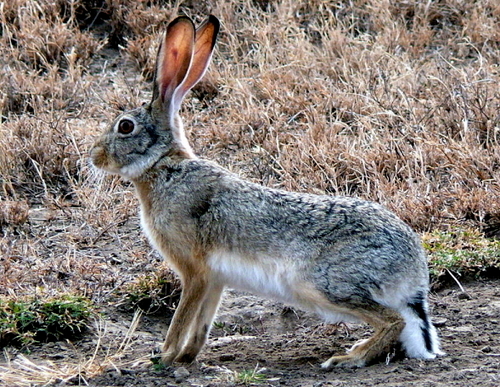
Medium-sized Cape Hare with speckled greyish-brown or sandy fur, a white belly, very long ears with black tips, and a tail with a black upper surface. It is confused with other sympatric African hares and difficult to distinguish from them in the field; genitalia and skull are the most reliable features.
Hind tracks are elongated and much larger than the fore tracks, 8-11 cm long, showing a typical lagomorph hopping pattern. Droppings are spherical and fibrous, 1-1.3 cm long, scattered in open grassland areas. It shelters by day in a form – a simple depression in the ground under a bush or clump of grass – and does not dig its own burrow.
Arid steppes, semi-arid deserts and open savanna with firm ground, from lowlands to high-altitude areas. Discontinuously distributed across North and South Africa and parts of the Middle East and Central Asia, with widely separated populations.
Herbivorous: grasses and herbaceous plants; obtains much of the water it needs from the vegetation it eats.
Solitary and nocturnal, without an actively defended territory. It breeds for much of the year in the warmer parts of its range, producing several litters of 1-3 young.
The Cape Hare maintains large and stable populations across most of its home range, with no signs of widespread decline. Its taxonomy, however, remains under review and may encompass several distinct species under this name.
Local hunting for meat and habitat loss from agricultural expansion occur in some areas, but there are no significant global threats.
See all species accounts for rabbits and hares · Full species index
Mammaling is a free app for logging the mammals you find. You record a sighting in a moment — even if it's just a track — your life list grows, and the record becomes available to scientific and conservation projects.
It runs on your phone with nothing to install. If you like, it adds to your home screen like any other app.
Open Mammaling