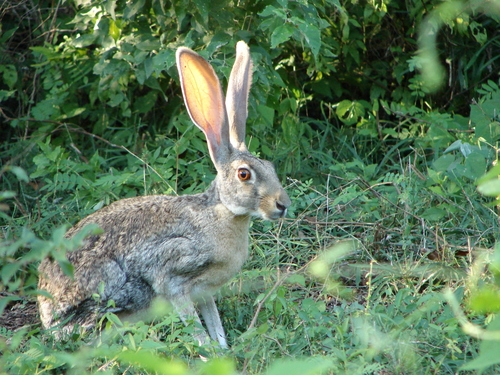
The Antelope Jackrabbit, the largest North American hare, inhabits the Sonoran Desert. It is recognisable from afar by its enormous ears, which function as radiators to dissipate the desert's extreme heat.
When it flees, it displays white flanks that flash with each stride. This striking effect is reminiscent of certain African antelopes and gives the species its name.
It does not dig burrows. Instead, it relies on its speed, capable of exceeding 60 km/h, and on the camouflage of its resting form in the shade of bushes. It is a symbol of the Sonoran Desert, adapted to some of North America's most extreme temperatures.
The Antelope Jackrabbit measures 47-63 cm long, weighing 3-4.3 kg. It is the largest hare in North America.
Its ears, up to 18 cm long, are notably longer than those of Lepus californicus. Its white flanks, visible when running, are diagnostic. They distinguish it from Lepus californicus and from Sylvilagus rabbits, which are much smaller and lack this white flash.
The dorsal fur is greyish and its hind legs are very long and muscular.
The Antelope Jackrabbit leaves elongated hind tracks 12-14 cm long, positioned well in front of the much smaller fore tracks, forming the typical Y-pattern when jumping. Its fur-covered soles leave a less defined track of the plantar pads than those of a dog or Coyote, which clearly mark pads and claws.
Droppings are pea-sized, round pellets of plant fibre, scattered throughout grazing areas.
It does not dig a burrow; instead, it uses a form – a shallow depression in the shade of a shrub – as its sole diurnal refuge.
The Antelope Jackrabbit inhabits scrubland and semi-desert of the Sonoran Desert, in Arizona and the Mexican states of Sonora and Sinaloa, generally at low altitudes.
It feeds on grasses, herbaceous plants and cacti, from which it also obtains much of the water it needs in the desert.
It is solitary and mainly crepuscular and nocturnal, avoiding the extreme heat of the day.
It does not hibernate or migrate.
When fleeing, it shows its white flanks as a visual alarm signal to other nearby Antelope Jackrabbits.
The Antelope Jackrabbit maintains stable and common populations within the Sonoran Desert, with no evidence of significant decline.
Conversion of desert scrub to irrigated agriculture and urban expansion in Arizona and Sonora reduce its available habitat, along with mortality from roadkill.
See all species accounts for rabbits and hares · Full species index
Mammaling is a free app for logging the mammals you find. You record a sighting in a moment — even if it's just a track — your life list grows, and the record becomes available to scientific and conservation projects.
It runs on your phone with nothing to install. If you like, it adds to your home screen like any other app.
Open Mammaling