Illustration generated with artificial intelligence from reference sources and reviewed by the team. Use it as a guide, not as a definitive identification key: it may contain errors in anatomical details such as the number of toes, claw marks or the scale. If something looks off, write to us at [email protected]: corrections from people who know the field are what keep improving these plates.
The European Rabbit is probably the wild mammal that has most unintentionally shaped the history of other species. Almost all domestic rabbit breeds worldwide descend from it, and its role as a keystone prey species sustains iconic predators such as the Iberian Lynx or the Spanish Imperial Eagle. The European Rabbit is native to the Iberian Peninsula and southwest Europe. However, for centuries it has been introduced across all continents except Antarctica, with a paradoxical result: in its original home, its populations have been in sharp decline for decades, while in places like Australia it has become one of the most damaging invasive species ever introduced.
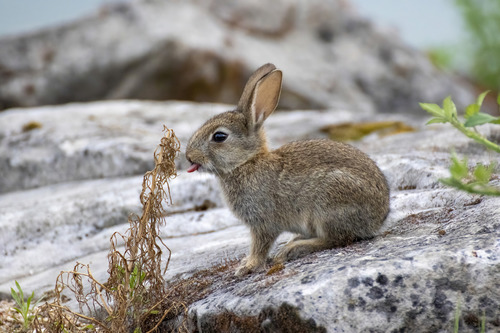
Small to medium-sized lagomorph. Its fur is greyish-brown with a paler belly. Its ears are shorter than a hare's and lack the characteristic black tips.
The European Rabbit differs from the European Hare by its smaller size, proportionally shorter ears and hind feet. It lives in excavated burrows rather than simple surface forms.
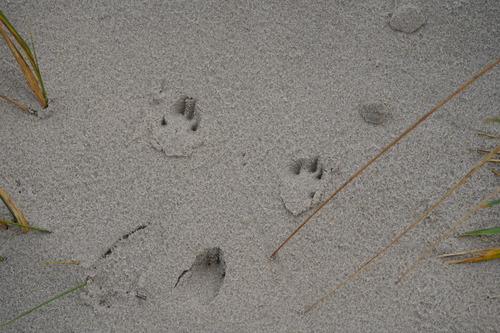
Tracks are small. Hind tracks are 3-4.5 cm long and somewhat more elongated than the fore tracks. Dense hair on the feet blurs the outline of the toes.
Droppings are spherical and fibrous, 0.8-1 cm in diameter, deposited in large quantities and often concentrated in small latrines near the burrow.
The clearest sign of its presence are warrens. These are systems of interconnected burrows with several entrances and mounds of excavated earth, often found on slopes with soft soil and good nearby vegetation cover.
Mediterranean scrubland, dehesa, grassland, and field margins with soft soil for digging, from lowlands to mid-mountain areas. Native to the Iberian Peninsula and southwest France; introduced and now fully feral across much of Europe, Australia, New Zealand, South America, and several oceanic islands.
Herbivore that grazes grass, tender vegetation and shoots near its burrow entrance, and in times of scarcity resorts to bark and roots.
Very social, it lives in colonies organised around shared burrow systems, with a clear dominance hierarchy among males. It is extraordinarily prolific, capable of producing several litters a year of 3-7 young each in favourable conditions. This reproductive strategy allows it to recover quickly after episodes of mass mortality.
Within its native home range in the Iberian Peninsula and southwest Europe, European Rabbit populations have suffered a very pronounced decline since the mid-20th century due to successive viral epidemics. In recent years, the trend appears to have stabilised in some areas, thanks to specific recovery programmes linked to the conservation of its predators. Outside its native home range, however, it maintains huge and expanding populations that cause serious ecological and agricultural damage, especially in Australia.
In its native range, two viral diseases introduced in the 20th century – myxomatosis and viral haemorrhagic disease – remain the primary cause of mortality and sharp population fluctuations for the European Rabbit. This is alongside the loss of traditional agricultural habitat. In areas where it is invasive, the species itself severely threatens native vegetation and agriculture.Okay, let's re-evaluate the
See all species accounts for rabbits and hares · Full species index
Mammaling is a free app for logging the mammals you find. You record a sighting in a moment — even if it's just a track — your life list grows, and the record becomes available to scientific and conservation projects.
It runs on your phone with nothing to install. If you like, it adds to your home screen like any other app.
Open Mammaling