The Broom Hare is found only in a handful of mountain ranges in northern Spain. It is an endemic species with such a restricted range that almost its entire global population, in terms of area occupied, would fit into a very small fraction of any European country.
It inhabits the high-mountain broom and heather scrub of the Cantabrian Mountains. This very specific habitat is partially shared with other European mountain hares, but they do not geographically overlap.
Described as a distinct species only in the second half of the 20th century, later than most European mammals, this was precisely due to the isolated and rarely visited nature of its mountain habitat.
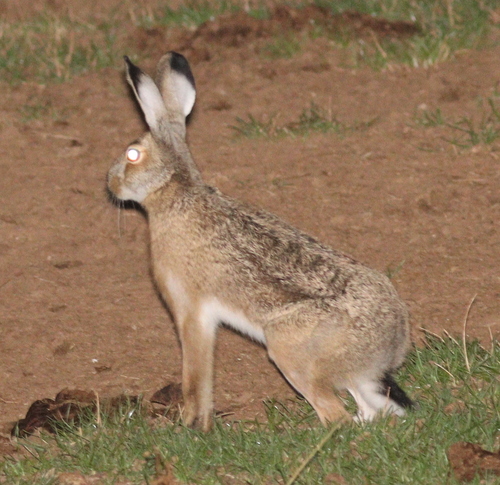
The Broom Hare is a medium-sized hare with dark brown fur and reddish tones. Its ears are shorter than those of the European Hare, with less black on the tips, and its tail has a dark upper side. It differs from the European Hare, with which it may overlap in lower-altitude areas of its range, by its darker colouring and proportionally shorter ears.
Elongated hind tracks, 9-12 cm long, larger than the front ones, with a jumping pattern characteristic of leporids. Spherical, fibrous droppings, 1-1.3 cm long, scattered throughout the high-altitude broom and heather where the Broom Hare grazes. The Broom Hare shelters by day in a form, a simple depression among high-mountain vegetation, without digging a burrow. Its presence is often revealed by tracks in snow during colder times of the year, when it is much easier to track than in summer.
Broom, heath, and high-mountain pasture, generally between 1000 and 2400 m altitude.
Endemic to the Cantabrian Mountains in the northern Iberian Peninsula. Its distribution range is very restricted and fragmented, and it is absent from the rest of Europe.
Herbivorous, the Broom Hare feeds on heather, broom, and high-mountain grasses, with its diet varying according to the seasonal availability of vegetation in its high-mountain habitat.
Solitary and discreet in its habits, the Broom Hare is mainly active at dusk and at night. Its home range is linked to high-mountain scrub patches. Reproduction is concentrated in spring and summer, with small litters adapted to a high-mountain habitat with limited resources.
The Broom Hare's home range is always restricted, as it is a high-mountain endemic. It is considered fragmented and shows signs of contraction in some of its mountain ranges. This keeps the species under constant surveillance, despite no widespread population collapse having been documented.
Climate change, reducing and displacing to higher altitudes the high-mountain habitat on which the Broom Hare depends, abandonment of traditional grazing practices that kept the scrubland open, and genetic isolation among the different mountain ranges it occupies.
See all species accounts for rabbits and hares · Full species index
Mammaling is a free app for logging the mammals you find. You record a sighting in a moment — even if it's just a track — your life list grows, and the record becomes available to scientific and conservation projects.
It runs on your phone with nothing to install. If you like, it adds to your home screen like any other app.
Open Mammaling