The Mediterranean Pine Vole spends almost its entire life underground, in a network of tunnels so extensive that it can travel several metres through agricultural soil without ever coming to the surface. This habit makes its behaviour much more similar to a mole's than to most of its vole relatives, which move freely on the surface. Its tiny eyes and ears, almost hidden in its fur, are good proof of how little it now needs sight or external hearing to survive in a world of total darkness underground.
Along with other species in its group, the Mediterranean Pine Vole is one of the few mammals capable of causing serious agricultural damage to root and tuber crops. This is precisely because it lives and feeds underground, leading to direct conflict with agriculture in areas where it is most abundant.
A small rodent with uniform greyish-brown fur, a cylindrical, compact body highly adapted to subterranean life, tiny, barely visible eyes, very small ears almost hidden in the fur, and a short tail. The Mediterranean Pine Vole differs from surface Voles in its much more cylindrical body and markedly reduced sensory organs. It differs from the Mole, with which it shares subterranean habits, by retaining visible eyes and fur, and by lacking the Mole's highly developed spade-like fore feet.
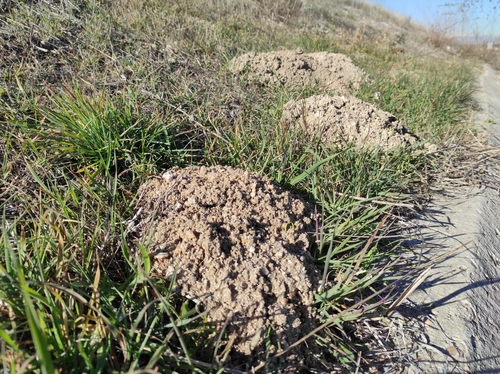
Due to its subterranean life, the Mediterranean Pine Vole leaves no conventional visible tracks. The clearest sign of its presence are small mounds of disturbed earth on the surface. These are more elongated and smaller than molehills, with the burrow entrance often visible at one end instead of completely covered.
Small, rounded droppings, 2-3 mm long, are found within the burrow system itself, rarely on the surface. Its presence is also revealed by roots and cultivated tubers gnawed from below. This is a characteristic damage pattern that differentiates the Mediterranean Pine Vole from other rodents that attack plants from the surface.
Found in soft soil in agricultural areas, meadows, orchards, and scrubland, where deep soil allows burrowing. Occurs from lowlands to low mountain areas. Distributed throughout southwest Europe, its presence centred on the Iberian Peninsula and southern France.
A subterranean herbivore, it feeds on roots, bulbs, tubers, and stem bases, consuming them directly from inside its burrows without needing to come to the surface.
The Mediterranean Pine Vole lives in family colonies within a system of underground galleries that can extend for several metres. It is active throughout the day and night within this temperature-stable underground environment.
It has a high reproductive capacity, producing several litters a year in favourable soil and food conditions.
The Mediterranean Pine Vole maintains generally numerous and stable populations in most of its range, with no signs of widespread decline. In some agricultural areas, it is considered a problematic species due to the damage it causes to root crops.
It faces no relevant conservation threats; on the contrary, it is subject to population control in some agricultural areas due to the economic damage it causes to root and tuber crops.
See all species accounts for rodents · Full species index
Mammaling is a free app for logging the mammals you find. You record a sighting in a moment — even if it's just a track — your life list grows, and the record becomes available to scientific and conservation projects.
It runs on your phone with nothing to install. If you like, it adds to your home screen like any other app.
Open Mammaling