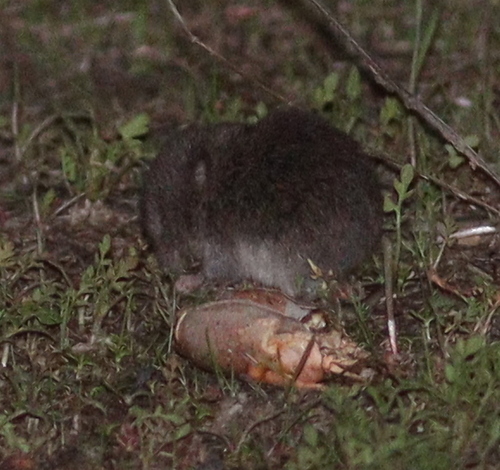
The Lusitanian Pine Vole is a small, discreet species endemic to the far southwest of Europe. It spends much of its life in shallow burrows under damp meadows and field edges, emerging to the surface mainly to move along a network of surface runways it keeps clear through dense grass. Its name refers to the Lusitanian region, specifically Portugal, where it was first described. However, its actual range also extends across much of the northwest Iberian Peninsula beyond that political border. It shares habitat and general appearance with other surface voles in the region. Reliable field identification almost always depends on being in an area where its range does not overlap with very similar-looking sister species.
Small rodent, fur greyish-brown to dark brown, compact body, eyes and ears visible but small, and a short tail, approximately one-third of the body length.
It can be confused with other surface voles in its region, especially the Southern Lusitanian Vole. Geographical distribution and, ultimately, genetic analysis are the most reliable ways to distinguish them.
Small track, 1.5-2 cm long, with 4 fore toes and 5 hind toes. Small, rounded droppings, 3-4 mm long, deposited alongside the surface runways it keeps clear through dense meadow vegetation or crop edges. It builds shallow burrows with several entrances visible as small holes in the grass. Its presence is revealed by narrow paths of cut and flattened grass, which are more pronounced in areas with damp, soft soil.
Damp meadows, grasslands, field edges and scrub with soft soil, from lowlands to mid-mountain areas. Distributed across the far southwest of Europe, present in Portugal and the northwest Iberian Peninsula.
Herbivorous, it feeds on grass, tender stems and shallow roots of the meadow and crop-edge vegetation in which it lives.
The Lusitanian Pine Vole lives in colonies, creating a system of surface runways through dense vegetation. It is active day and night. It has a relatively high reproductive capacity, producing several litters a year when humidity is favourable and tender vegetation is available.
The Lusitanian Pine Vole maintains generally stable populations throughout most of its range, with no signs of widespread decline. However, locally, it can be affected by the conversion of damp meadows for intensive agricultural use.
Drainage and agricultural transformation of wet meadows, and in some areas, the use of rodenticides in crops adjacent to its habitat.
See all species accounts for rodents · Full species index
Mammaling is a free app for logging the mammals you find. You record a sighting in a moment — even if it's just a track — your life list grows, and the record becomes available to scientific and conservation projects.
It runs on your phone with nothing to install. If you like, it adds to your home screen like any other app.
Open Mammaling