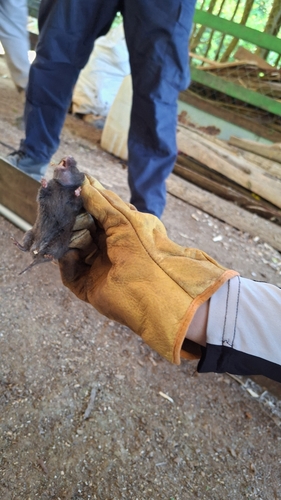
A vole with almost entirely subterranean habits, far more fossorial than most of its relatives in the genus, with a compact body and small eyes and ears that reflect a life spent largely underground or beneath a dense layer of vegetation. It lives in the pine and mountain cloud forests of a strip of eastern Mexico, near the city of Xalapa which gives the Jalapan Vole its common name. Like other voles, it feeds almost exclusively on plant material, and its continuous digging activity helps to aerate the forest soil. It is one of several vole species endemic to the Mexican mountains whose detailed biology remains poorly known despite being described over a century ago.
A small, highly compact rodent with a cylindrical body, very short tail, small eyes and ears owing to its more fossorial habits than other voles, and dark brown fur. It differs from other voles in the region by this appearance more adapted to life underground, with proportionally smaller ears and eyes.
Tiny track, barely 1-1.5 cm, showing 4 foretoes and 5 hind toes, rarely visible given its more subterranean habits than other voles. Small, cylindrical droppings 4-6 mm long, deposited inside its system of shallow galleries and rarely seen on the surface. It digs a network of shallow tunnels beneath the leaf litter and dense vegetation of the pine and cloud forest, with occasional small surface openings semi-hidden among the vegetation.
Pine forest and mountain cloud forest with soft soil and abundant leaf litter, generally between 1500 and 3000 m altitude. Distributed across a strip of mountains in eastern Mexico, in the states of Veracruz, Puebla and Hidalgo.
Herbivorous, feeding on roots, tender stems, grass and seeds from the mountain forest floor.
More fossorial than most voles, it digs a network of shallow tunnels beneath the leaf litter and is solitary and territorial outside the breeding season.
Its populations are generally considered stable across much of its range, although declining locally due to the loss of pine and cloud forest in parts of the mountains of eastern Mexico.
Deforestation and fragmentation of pine and cloud forest caused by logging and land-use changes in the mountains of Veracruz, Puebla and Hidalgo.
See all species accounts for rodents · Full species index
Mammaling is a free app for logging the mammals you find. You record a sighting in a moment — even if it's just a track — your life list grows, and the record becomes available to scientific and conservation projects.
It runs on your phone with nothing to install. If you like, it adds to your home screen like any other app.
Open Mammaling