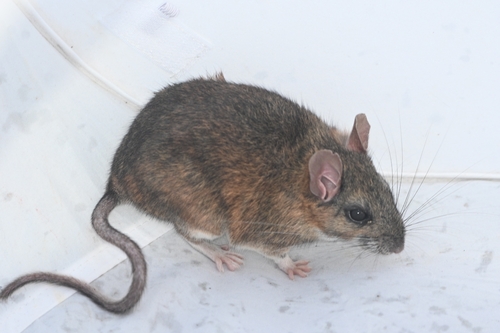
Few field rats have a home range as wide as the Mexican Woodrat: it lives in rocky canyons from southern Utah and Colorado to the mountains of Honduras, crossing practically all of Mexico along the way. It is a species of rugged terrain, preferring rock faces, slopes and mountain forests over open plains. Its nest, tucked into cracks and hollows among rocks, is more discreet than those of other Neotoma species that pile branches in plain sight; here, much of the structure remains hidden within the rock itself.
Greyish-brown or orange fur above, white belly, and a long, bushy tail, paler underneath. It differs from Common Rats by its blunt snout, large eyes and ears, and a fur-covered rather than scaly tail. It coexists over much of its home range with other Neotoma species, from which it can only be reliably distinguished by skull morphology or genetics. However, its close association with rocky areas aids field identification.
The Mexican Woodrat seeks rock crevices and stony slopes to build partial mounds of branches, lichens, and plant remains. These are often visible only as a plug of vegetation protruding from a crevice. Tracks, 1.5-2 cm long, have four fore toes and five hind toes. They are smaller and lack the elongated claw mark of a dog or fox. Droppings, cylindrical and about 1 cm long, accumulate in small latrines near the refuge entrance. Their presence next to a crevice with fresh plant remains is the most reliable indication of active occupation.
Canyons, rocky areas and mountain forests, from low semi-arid areas up to over 3000 m in altitude in some parts of its range.
It is discontinuously distributed from the southwestern United States to Honduras, following mountain ranges.
Acorns, pine nuts, juniper berries and other seeds and fruits from mountain vegetation, along with leaves and fungi occasionally.
Solitary and nocturnal, it shelters by day in rocky crevices. Gestation lasts 30-38 days, typical for the genus. Litters of 2-4 young can be repeated several times a year in populations from more temperate areas.
The Mexican Woodrat is stable throughout most of its range, thanks to its wide distribution and the variety of rocky habitats it occupies. It ranges from the southwestern United States to Central America. There are no indications of widespread decline, although specific population data are lacking for much of the Central American populations.
Loss and fragmentation of mountain forest due to logging and land-use change in some areas of its Mexican and Central American range.
See all species accounts for rodents · Full species index
Mammaling is a free app for logging the mammals you find. You record a sighting in a moment — even if it's just a track — your life list grows, and the record becomes available to scientific and conservation projects.
It runs on your phone with nothing to install. If you like, it adds to your home screen like any other app.
Open Mammaling