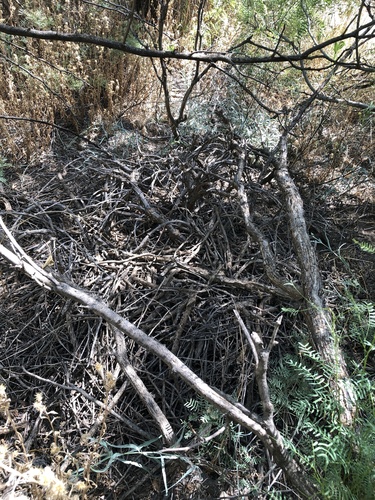
In the southern plains of North America, the Southern Plains Woodrat builds veritable plant fortresses: mounds of branches and prickly pear pads that can exceed 1 metre wide. These serve as shelter for successive generations. It lives in semi-arid scrubland areas of Texas, Oklahoma, Kansas, New Mexico, and Colorado, extending into northern Mexico. Its association with prickly pear is so close that much of its diet, dwelling, and defence depend on this spiny plant.
Fur grey-brown above and white below, with a long tail covered in short hair, darker above. It is distinguished from common rats by its large ears, prominent eyes, and furry rather than scaly tail. The Southern Plains Woodrat is confused with other *Neotoma* species in the region, especially with the White-throated Woodrat (N. albigula). Reliable distinction from the latter requires skull morphology or genetic analysis, though its mound is typically larger and denser with prickly pear pads.
The clearest sign is the mound itself. This is an accumulation of thorny branches, prickly pear pads, bones, and various refuse at the base of a shrub, yucca, or prickly pear plant. It can exceed a metre in diameter and remain in continuous use for years by different generations. Tracks, 1.5-2 cm long, show four fore toes and five hind toes, lacking the long, deep claw mark characteristic of a dog. Droppings, cylindrical and 0.8-1.2 cm long, gather in latrines inside or next to the mound instead of being dispersed. This helps differentiate them from the droppings of rodents without a fixed refuge.
Semi-arid scrubland and grassland with prickly pear, mesquite, and rocky outcrops, from the southern Great Plains of the United States to northern Mexico.
Prickly pear pads and fruits, mesquite pods, and other seeds and leaves from scrubland shrubs; prickly pear also provides much of the water it needs.
Solitary, territorial, and nocturnal, the Southern Plains Woodrat defends its mound from other individuals of its species. Gestation lasts 30-38 days, with litters of 2 to 4 young. It can breed several times a year.
The Southern Plains Woodrat has a stable and widely distributed population across the plains of the southern United States and northern Mexico. There are no signs of significant decline, nor specific conservation measures in place.
Conversion of scrubland and grassland to irrigated agriculture, and removal of prickly pear thickets during grazing land management.
See all species accounts for rodents · Full species index
Mammaling is a free app for logging the mammals you find. You record a sighting in a moment — even if it's just a track — your life list grows, and the record becomes available to scientific and conservation projects.
It runs on your phone with nothing to install. If you like, it adds to your home screen like any other app.
Open Mammaling