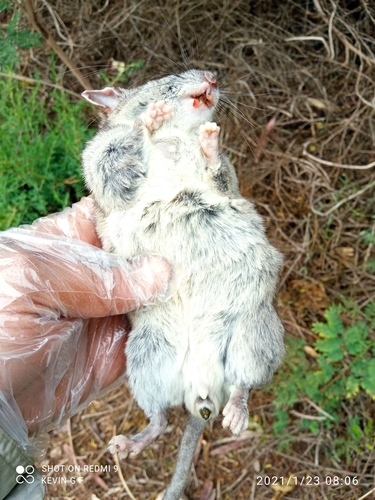
The Sonoran Woodrat lives only in a narrow strip of the Sonoran coast, beside the Gulf of California, where the desert reaches almost to the water. It is one of the least studied *Neotoma* in Mexico, with such a restricted range that much of what is known about it comes from a few localities. It shares the coastal scrub landscape with large columnar cacti, under whose protection it builds its refuge.
Fur greyish-brown above and pale below, medium-sized for the genus, with a moderately long, bushy tail.
It can be confused with other woodrats of northwestern Mexico, especially forms of White-throated Woodrat (Neotoma albigula) found in the same coastal area. Reliable distinction requires examination of skull morphology or genetic analysis.
The Sonoran Woodrat builds mounds of branches and spiny cactus segments at the base of shrubs or columnar cacti in coastal scrubland. As with other species in the genus, this structure protects the entrance with accumulated spines. Tracks, 1.5 cm long, show four fore toes and five hind toes, lacking the deep claw mark of a similarly sized canid. Droppings are concentrated in small latrines inside the mound, not dispersed throughout the home range.
Arid coastal scrub of the Sonoran coast, in the Gulf of California, a very restricted and little-studied range.
Cacti and shrubs of coastal scrubland, in a pattern similar to that of other desert Neotoma species.
Solitary and nocturnal. No specific published data exist on its reproduction; it is assumed to be similar to other species in the genus, with a gestation of 30-38 days.
No significant population declines have been detected, but its very restricted range and the scarcity of field studies make any change in the coastal habitat of Sonora difficult to monitor.
Tourist and real estate development on the coast of Sonora, which reduces the available coastal scrub within an already small range.
See all species accounts for rodents · Full species index
Mammaling is a free app for logging the mammals you find. You record a sighting in a moment — even if it's just a track — your life list grows, and the record becomes available to scientific and conservation projects.
It runs on your phone with nothing to install. If you like, it adds to your home screen like any other app.
Open Mammaling