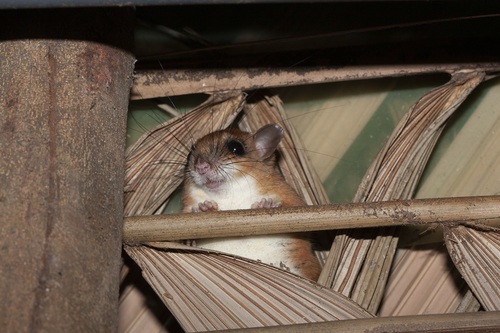
With its large black eyes, reddish fur, and almost entirely arboreal life, Sumichrast's Vesper Rat looks more like a small dormouse than the typical terrestrial rodent one imagines when hearing 'rat'.
It lives in humid and cloud forests from southern Mexico to Panama. It spends its life climbing through vegetation, where it builds spherical nests, layering them one upon another, in tree hollows and branch forks.
Its name refers to Sumichrast, the Swiss-French naturalist who worked in Mexico in the 19th century. Its biology remains little known precisely because of the difficulty of observing such an arboreal and nocturnal animal.
Its fur is bright orange or reddish above and white below, with large, dark eyes and rounded ears, typical adaptations of a nocturnal and arboreal mammal. Its long, bushy tail serves as a support when climbing. It differs from other arboreal rodents in its range by its vivid fur colouring and disproportionately large eyes. It is only confused with other tropical arboreal rats in poor visibility.
It builds spherical nests up to 10 cm in diameter, with a hollow central cavity, in tree hollows or branch forks. It often builds a new nest on top of an old one, forming multi-layered structures over time.
It rarely leaves recognisable tracks on the ground due to its almost exclusively arboreal life. Small, elongated droppings accumulate under trees it frequents most regularly, though the most reliable sign of its presence remains the spherical nest itself, high up.
Humid tropical forest, cloud forest and tall secondary vegetation, from southern Mexico to Panama, especially in areas with continuous tree canopy.
Fruits, seeds, and tender leaves, occasionally supplemented with insects; it forages almost entirely among branches, rarely descending to the ground.
Nocturnal and strictly arboreal, Sumichrast's Vesper Rat rarely touches the ground. It builds and reuses spherical nests for generations, and the young are born and raised in these same elevated nests.
Sumichrast's Vesper Rat is considered widely distributed and tolerant of some habitat alteration, with confirmed presence in several protected areas of Mesoamerica. However, its arboreal habits make it difficult to accurately estimate its population size.
Loss of mature forest with continuous canopy due to logging and agricultural expansion in some areas of its Central American range.
See all species accounts for rodents · Full species index
Mammaling is a free app for logging the mammals you find. You record a sighting in a moment — even if it's just a track — your life list grows, and the record becomes available to scientific and conservation projects.
It runs on your phone with nothing to install. If you like, it adds to your home screen like any other app.
Open Mammaling