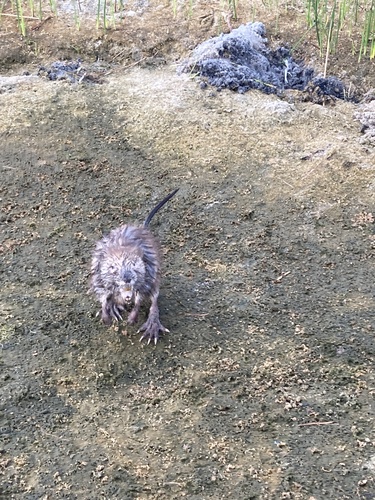
Despite its name and large rodent appearance, it is not related to rats but to voles and lemmings. Its long tail, flattened laterally like an oar, gives it away instantly as a fine swimmer. It builds mounds of interwoven aquatic vegetation, remarkably like those of a miniature beaver, which serve as shelter and above-water feeding platforms through the winter. Native to North America, it was deliberately introduced to Europe and Asia in the early 20th century for its fur. There it has become an invasive species capable of damaging dykes and canals by burrowing into their banks. Its perineal glands produce a strongly musky secretion used to mark territory, which gives the species its name in both Spanish and English, as the Common Muskrat.
A medium-large rodent with dense, waterproof dark brown fur and a long, hairless, laterally flattened tail very different from a rat's rounded tail. It differs from the Brown Rat by its larger size, its laterally flattened rather than rounded tail, and its strictly aquatic habits. It is distinguished from the European Beaver by its much smaller size and its vertically rather than horizontally flattened tail.
Track with 5 partially webbed hind toes and 4 front toes, the hind track 5-6 cm long; distinguished from a rat track by the partial interdigital webbing and by appearing almost exclusively near water. Droppings small and elongated, 1-1.5 cm long, frequently deposited on emergent rocks or logs near the bank as a latrine. The most recognisable tracks and signs are the mounds of heaped aquatic vegetation, 1 m or more in diameter, protruding from the water in marshes and shallow water areas, together with surface runways of cut vegetation in the water leading to the submerged entrance of the burrow or mound.
Marshes, lakes, slow-flowing rivers and canals with abundant aquatic vegetation. Native to North America, from northern Mexico to southern Canada and Alaska; introduced and now widely established in Europe and Asia, where it is considered an invasive species.
Herbivorous, feeding mainly on aquatic and riparian vegetation, supplemented occasionally with molluscs and other small aquatic invertebrates.
Lives in small family groups within a system of burrows or mounds. Activity continues year-round even under ice, using the mounds as feeding platforms in winter. It may produce several litters a year in the warmer parts of its range.
Native North American populations are considered stable across most of their range. Introduced populations in Europe and Asia continue to expand and are subject to control programmes due to the damage they cause to water infrastructure.
In its native range it faces no significant threats at species level; locally it suffers from wetland loss and water pollution.
See all species accounts for rodents · Full species index
Mammaling is a free app for logging the mammals you find. You record a sighting in a moment — even if it's just a track — your life list grows, and the record becomes available to scientific and conservation projects.
It runs on your phone with nothing to install. If you like, it adds to your home screen like any other app.
Open Mammaling