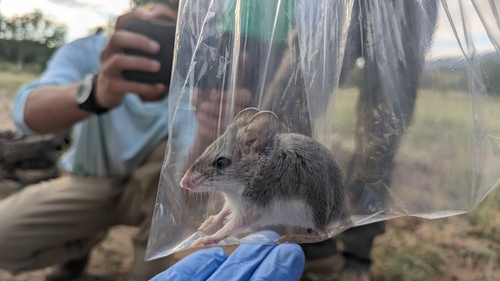
The Southern Grasshopper Mouse made its genus famous by hunting venomous Centruroides scorpions without flinching. Its nervous system has evolved to block the pain the venom causes in most mammals. It lives in the deserts of the southwestern United States and northwestern Mexico. Like its two American relatives, it stands on its hind feet and emits a sharp howl before finishing off large prey. Proportionate to its size, it is one of the most predatory rodents on the continent.
Compact body, fur pinkish-brown or cinnamon above and pure white below, with a short, thick tail with a white tip. It can be confused with the Mearns' Grasshopper Mouse (O. arenicola) and, in areas of overlap, with the Northern Grasshopper Mouse (O. leucogaster). Reliable identification of the three species depends on cranial characteristics, as they are almost identical externally.
The tracks are compact, showing four toes on the fore feet and five on the hind feet, without the drag mark of a long tail, unlike the Peromyscus with which it shares its habitat. Droppings, 0.7-1 cm long, often contain visible fragments of insect exoskeleton and even scorpion stinger remains. The most characteristic sign is the accumulation of prey remains (legs, elytra, stingers) near the burrow entrance. Occasionally, its sharp howl can be heard at dusk, audible up to a hundred metres away.
Desert and arid scrubland with loose soils, from southern Nevada and California to northern Sinaloa and Baja California, in Mexico.
Insects and other arthropods, including scorpions of the genus Centruroides, and occasionally small vertebrates; it actively hunts instead of gathering seeds.
Solitary and territorial, the Southern Grasshopper Mouse marks its territory with a high-pitched howl. It emits this while standing on its hind feet, with its snout raised, just before dispatching larger prey. It does not hibernate and remains active throughout the year.
The Southern Grasshopper Mouse is considered common with a stable population throughout most of its range in southwestern North America, with no signs of widespread decline.
Habitat loss of desert scrub due to urban and agricultural expansion in some areas of its range.
See all species accounts for rodents · Full species index
Mammaling is a free app for logging the mammals you find. You record a sighting in a moment — even if it's just a track — your life list grows, and the record becomes available to scientific and conservation projects.
It runs on your phone with nothing to install. If you like, it adds to your home screen like any other app.
Open Mammaling