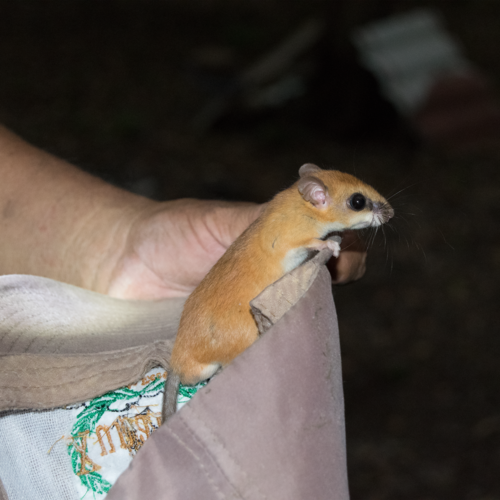
The Yucatán Vesper Rat is the sole species in its genus and a true climber. It has been found on dead logs, vines, coconut palms, and, in one documented case, occupying an abandoned woodpecker nest almost two metres up a dead tree. It lives exclusively on the Yucatán Peninsula and in neighbouring areas of Central America. Its young are born particularly helpless, blind, and naked, which necessitates prolonged maternal care, unusual among rodents of its size.
It has a body 9-12 cm long, with a tail 6-13 cm long, vivid, contrasting fur, and large, rounded ears, which give it its name.
It differs from the Orejona Climbing Rat (Ototylomys phyllotis), which shares part of its range in the Yucatán Peninsula. The Yucatán Vesper Rat has more vivid colouring and prefers
No published descriptions exist of characteristic tracks or droppings for field identification. Its presence is primarily detected by locating nests in dead logs, tree hollows, or abandoned Woodpecker nests 1-2 m high. These are the most recognisable indirect sign of the Yucatán Vesper Rat.
It lives in semi-deciduous tropical forest and vegetation near water of the Yucatán Peninsula, in the Mexican states of Campeche, Yucatán, and Quintana Roo, as well as northern Guatemala and Belize.
It feeds on seeds, both on the ground and in shrubs, and on soft-fleshed fruits.
The Yucatán Vesper Rat has markedly arboreal habits for a rodent of its family. Its young are born in a very immature state, blind and hairless, which implies prolonged dependence on the mother compared to other rodents of similar size.
The Yucatán Vesper Rat is listed as Least Concern by the IUCN, thanks to its relatively wide distribution across the Yucatán Peninsula and its tolerance of some habitat alteration. However, in Mexico it is categorised as a threatened species under national regulations.
Deforestation of the Yucatán Peninsula's rainforest for agricultural and livestock farming is the main pressure on its habitat.
See all species accounts for rodents · Full species index
Mammaling is a free app for logging the mammals you find. You record a sighting in a moment — even if it's just a track — your life list grows, and the record becomes available to scientific and conservation projects.
It runs on your phone with nothing to install. If you like, it adds to your home screen like any other app.
Open Mammaling