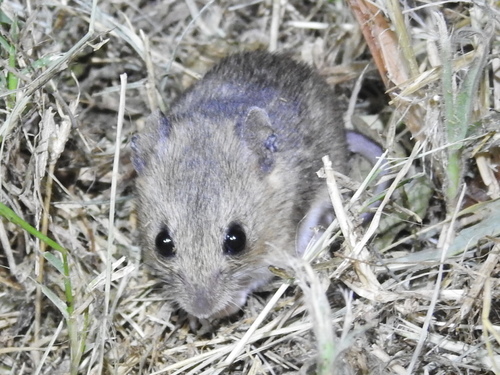
One of the smallest harvest mice of the North American prairies, its presence says much about the state of the grassland: it prefers well-drained, short, almost pristine grass, and is scarce in tall or degraded grass areas. In areas with human activity it does not turn down a ready-made nest, taking up residence in abandoned bird nests or even old cans if they provide shelter. Unlike many temperate rodents, the Plains Harvest Mouse remains active all year round without entering hibernation, so its tracks and signs can be found in the depth of winter.
A very small harvest mouse, with a head-body length of around 67 mm and a tail 20-69 mm long which, unlike most of its relatives, is always shorter than the body, never longer. Weight barely reaches 7 g. This short tail is the key to separating it in the hand from sympatric species such as R. megalotis or R. fulvescens, in which the tail equals or exceeds head-body length.
Like the rest of the genus, it is too small to leave recognisable tracks in the field. It builds spherical nests of woven grass, situated slightly above the ground amongst vegetation or directly on the terrain. It is not uncommon for it to use abandoned bird nests or even cans and other artificial cavities in areas of human contact, an unusual behaviour for the genus. The short tail of the animal itself, visible if captured, is the most reliable feature to differentiate it in the hand from other Reithrodontomys species in the same area.
Well-drained grassland, close to climax state, with a preference for short grass; it is scarce in tall-grass prairies. Distributed across the central United States and northern Mexico.
Herbivorous-insectivorous: feeds mainly on grass seeds and vegetation, with a smaller proportion of insects.
Active all year round, without hibernating. Young are born hairless and blind, developing hair at 6 days, opening their eyes at 8 days, and being weaned around 14 days of age.
Widespread species across the Great Plains of North America, with no evidence of overall decline, though locally sensitive to the loss of well-preserved grassland.
Conversion of well-preserved native grassland into farmland or grassland degraded by overgrazing.
See all species accounts for rodents · Full species index
Mammaling is a free app for logging the mammals you find. You record a sighting in a moment — even if it's just a track — your life list grows, and the record becomes available to scientific and conservation projects.
It runs on your phone with nothing to install. If you like, it adds to your home screen like any other app.
Open Mammaling