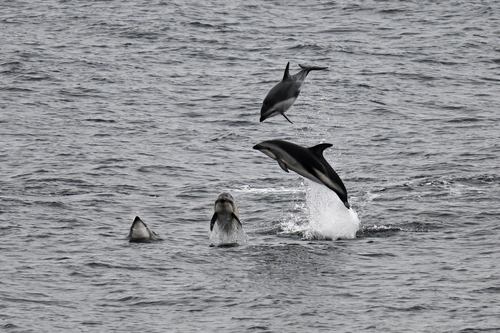
Few dolphins are so acrobatic: it leaps, spins on its own axis and can string together dozens of jumps in a row. The behaviour is so striking that it has become the main reason much of the whale-watching tourism of the southern hemisphere is organised around this species. It lives in three widely separated regions of the southern hemisphere — the coasts of South America, southern Africa and New Zealand — with almost no contact between these populations, which has produced marked genetic differences among them. In 2025 it was reclassified, together with its North Pacific relative, in a genus of its own, split off from the former Lagenorhynchus.
Medium-sized body with hardly any distinct beak, a dark diagonal stripe running along the flank from the dorsal fin towards the tail, and two characteristic pale stripes near the base of the tail. The dorsal fin is curved and blunt-tipped. It differs from the Striped Dolphin in its simpler colour pattern and lack of a beak, and from Commerson's Dolphin in its larger size and less rounded dorsal fin.
Like all cetaceans, it leaves no usable tracks or droppings. It is detected by its very characteristic surface behaviour: frequent acrobatic leaps, often in groups, and cooperative hunting visible from the coast when it herds shoals of fish near the surface.
Cool and temperate coastal waters of the continental shelf of the southern hemisphere, in separate populations off South America (Peru, Chile, Argentina), southern Africa and New Zealand.
Shoaling fish and squid, caught with cooperative hunting tactics that vary by area: herding fish shoals by day and feeding in deep scattering layers at night.
Lives in groups of highly variable composition (fission-fusion), which change in size with food availability and the presence of predators. Very acrobatic, with frequent leaps, spins and tail slaps out of the water.
The species as a whole is considered low risk thanks to its wide distribution, but that global assessment hides a very different situation in the Peruvian and Chilean subpopulation. This was assessed separately as Vulnerable because of bycatch and direct catch in artisanal fisheries, which in the past exceeded 7,000 animals caught per year.
Bycatch and, in the past, direct catch in artisanal and industrial fishing nets, especially on the coast of Peru, and degradation of coastal habitat by fishing and aquaculture in some areas.
See all species accounts for even-toed ungulates · Full species index
Mammaling is a free app for logging the mammals you find. You record a sighting in a moment — even if it's just a track — your life list grows, and the record becomes available to scientific and conservation projects.
It runs on your phone with nothing to install. If you like, it adds to your home screen like any other app.
Open Mammaling