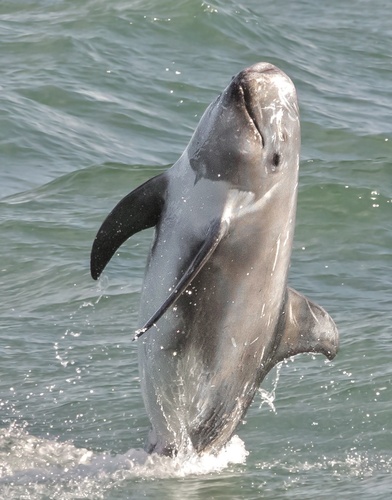
Adult Risso's Dolphins have bodies covered in criss-crossing white scars, a living map of decades of fights with sharp-beaked squid and rubs with other individuals of their own species. Older individuals can become almost entirely white from the accumulation of marks on their original grey skin. It has a bulky, rounded head with a very characteristic vertical crease in the centre, a feature no other European or global dolphin displays with such clarity. It is a deep-water diver, almost entirely specialised in squid, making it a good indicator of the health of cephalopod populations in an area.
A medium-large delphinid, Risso's Dolphin has a robust grey body that lightens and becomes covered in criss-crossing white scars with age. Its head is rounded with a well-marked central vertical crease and no distinct beak. The dorsal fin is high and very falcate. It differs from other round-headed dolphins, such as the Pilot Whale, by its dense pattern of white scars and its higher, narrower dorsal fin.
It leaves no tracks on land; it is detected by a low blow, followed by the emergence of its back with the tall, falcate dorsal fin clearly visible. With age, its body acquires a very characteristic whitish appearance due to the accumulation of scars, which facilitates its identification at a distance from other dolphins with similar heads. It emits high-frequency echolocation clicks used for hunting squid at great depths, and often displays jumping and pectoral fin slapping behaviour more frequently than other deep-diving dolphins.
Deep oceanic waters, generally over the continental slope and submarine canyons, in temperate and tropical waters worldwide. Widely distributed throughout the Atlantic, Pacific, and Indian Oceans, commonly found in areas of complex submarine topography where squid are abundant.
It feeds almost exclusively on squid and other cephalopods, caught through deep dives guided by echolocation.
Social, Risso's Dolphin lives in variable-sized groups, from a few individuals to several tens. Its social structure is less studied than that of other dolphins. It undertakes movements linked to the seasonal availability of squid in areas of the continental slope.
Globally, its populations are generally considered stable, although a lack of studies across much of its oceanic range hinders accurate determination of regional trends, except in some better-monitored coastal areas.
Bycatch in offshore fishing gear; noise pollution, which may interfere with its echolocation when hunting deep-sea squid; and pollution by persistent compounds accumulated in its blubber.
See all species accounts for even-toed ungulates · Full species index
Mammaling is a free app for logging the mammals you find. You record a sighting in a moment — even if it's just a track — your life list grows, and the record becomes available to scientific and conservation projects.
It runs on your phone with nothing to install. If you like, it adds to your home screen like any other app.
Open Mammaling