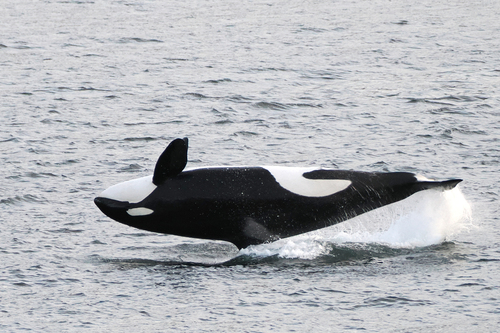
In 2024, a genetic and morphological study proposed separating Bigg's Killer Whales – the transient killer whales of the North Pacific – as a distinct species. These whales specialise in hunting marine mammals and coexist in the same waters with fish-eating Resident Killer Whales, having barely interbred for hundreds of thousands of years. The taxonomy committee of the Society for Marine Mammalogy reviewed the proposal
Typical Bigg's Killer Whale colouring, black above and white below, with a large white eye patch and a grey saddle patch behind the dorsal fin. It differs from the Resident Killer Whale, which shares its range, by a more pointed and triangular dorsal fin, a wider, closed, uniformly grey saddle patch with no open areas revealing the black background, and a more robust head and jaw. The eye patch usually slopes downwards and backwards, whereas in the Resident Killer Whale it tends to be more horizontal.
It travels in much smaller groups than the Resident Killer Whale, typically 2 to 6 individuals compared to the latter's groups of tens or hundreds.
As it is not a terrestrial mammal, Bigg's Killer Whale leaves no traceable tracks or droppings. It is mainly located by its blow (the column of vapour exhaled, visible for several kilometres in good conditions) and by direct sightings of its dorsal fin and saddle patch.
The most characteristic sign of this marine mammal-hunting ecotype is prey remains floating on the surface after an attack: fat, skin, and fragments of seal, porpoise, or other cetacean. These are often accompanied by gulls concentrated over the kill site. Unlike the Resident Killer Whale, which vocalises frequently while locating fish shoals, this ecotype hunts almost silently to avoid revealing its presence to prey with good hearing. Consequently, its passive acoustic detection is much less reliable than direct visual observation.
Coastal and oceanic waters of the North Pacific, from California to the Bering Sea and the Aleutian Islands, with occasional presence further south. It moves across a very wide home range, following prey availability.
Marine mammals (seals, sea lions, porpoises, dolphins and, occasionally, other whales) are hunted by pursuit and coordinated attack in small groups.
Bigg's Killer Whale travels in small, flexible groups, usually centred on a female and her offspring, which are very different from the large, stable groups of the Resident Orca. It hunts silently, reducing vocalisations while stalking so as not to alert prey with good hearing. It only vocalises freely after completing a capture. Adult males can travel alone or temporarily join other groups.
Populations of Bigg's Killer Whale are considered largely stable or increasing in the North Pacific, favoured by the recovery of seal and sea lion populations in recent decades. This contrasts with the decline of the Southern Resident Killer Whale, which depends on increasingly scarce salmon.
Persistent pollutants (PCBs and other organochlorine compounds) accumulate through their prey, concentrating particularly in males and in the first young of each female. Collisions and disturbance from maritime traffic in busy coastal areas are also threats.
See all species accounts for even-toed ungulates · Full species index
Mammaling is a free app for logging the mammals you find. You record a sighting in a moment — even if it's just a track — your life list grows, and the record becomes available to scientific and conservation projects.
It runs on your phone with nothing to install. If you like, it adds to your home screen like any other app.
Open Mammaling