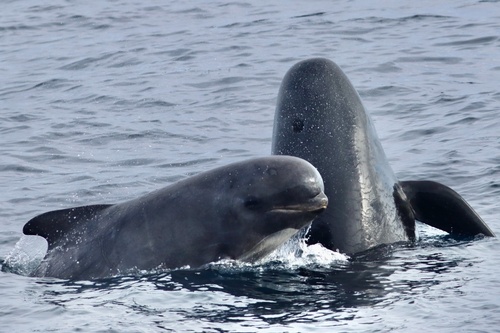
Long-finned Pilot Whales live in such close-knit matriarchal societies that older females stop reproducing long before they die, dedicating the rest of their lives to guiding and helping raise subsequent generations. This is a phenomenon of functional menopause known in only a handful of mammal species, including humans and Orcas. Despite being called a 'whale', the Long-finned Pilot Whale is actually the second largest delphinid after the Orca, with a very characteristic bulbous, rounded head. Along with the False Killer Whale, it is one of the species most involved in mass strandings, episodes where tens or hundreds of individuals from the same family group become beached together on the coast. This is possibly due to strong social cohesion, which prevents healthy members from abandoning sick or disoriented individuals in the group.
A large delphinid, it has a robust black or very dark grey body with a pale anchor-shaped patch under the chin. Its head is domed and rounded with no distinct beak. The dorsal fin is low and set very far forward compared to other dolphins. It is distinguished from the False Killer Whale, which has a more conical and narrower head. It also differs from the Short-finned Pilot
The Long-finned Pilot Whale leaves no tracks on land. It is detected by a low, frontal blow, followed by a slow emergence of the back with its very characteristic low, forward-set dorsal fin. It is very social and usually sighted in numerous, compact groups, sometimes including dozens of individuals swimming very close to each other. Underwater, it emits whistles and echolocation clicks used for group cohesion. It also relatively frequently features in mass strandings of entire family groups, one of the clearest and most tragic indications of its presence on a coast.
Deep oceanic waters, both temperate and subpolar, generally over the continental shelf break, with seasonal movements linked to prey availability. Discontinuously distributed across the North and South Atlantic and parts of the Southern Hemisphere, with a separate population in the North Pacific sometimes considered a distinct species or subspecies.
It feeds mainly on squid, supplemented with deep-water fish, caught by dives that can exceed several hundred metres in depth.
Extremely social, the Long-finned Pilot Whale lives in stable matrilineal groups of several tens of individuals. These are led by older females, some of whom stop reproducing long before they die. This strong social cohesion is related to its tendency to mass strand, as the group tends to stay together even when some individuals are sick or disoriented.
The lack of sufficient population data across much of its oceanic range prevents an accurate understanding of the global population trend for the Long-finned Pilot Whale. However, some areas with active traditional hunting, such as the North Atlantic, have capture series that suggest some regional stability.
Active traditional hunting in some areas of the North Atlantic, bycatch in offshore fishing gear, pollution by heavy metals and persistent organic compounds accumulated in its blubber, and mass strandings for reasons not always clear.
See all species accounts for even-toed ungulates · Full species index
Mammaling is a free app for logging the mammals you find. You record a sighting in a moment — even if it's just a track — your life list grows, and the record becomes available to scientific and conservation projects.
It runs on your phone with nothing to install. If you like, it adds to your home screen like any other app.
Open Mammaling