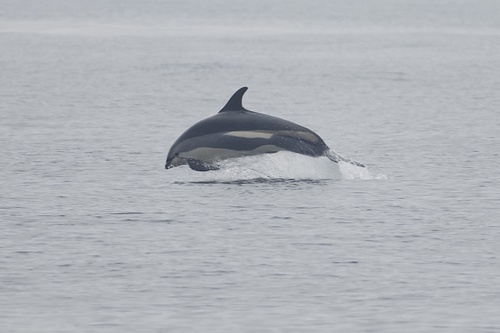
It sports a bright yellow stripe along its flank, near the tail. This stands out against the rest of its grey and black body, giving it a much more colourful appearance than most cold-water dolphins it shares the North Atlantic with.
It is an extremely fast and acrobatic swimmer, often leaping completely out of the water and accompanying vessels at high speed. This behaviour is much more exuberant than that of its White-beaked Dolphin relative, with which it is often confused in the same range.
Its taxonomic classification has changed in recent years, moving into its own genus, distinct from other dolphins it was previously grouped with. This reflects how much genetics continues to redefine the oceanic dolphin tree.
The Atlantic White-sided Dolphin is a medium-sized dolphin with a robust black and grey body. It has a bright yellow stripe on its side near the caudal peduncle and a white band along its flank. Its beak is short and well-differentiated, and its dorsal fin is high, very falcate, and bicoloured.
It differs from the White-beaked Dolphin by its very characteristic yellow stripe, which is absent in its relative. Its overall colour pattern is also more contrasted and striking.
The Atlantic White-sided Dolphin leaves no tracks on land. It is detected by a low blow, followed by a rapid emergence of its back with the high, falcate dorsal fin clearly visible. It is very active and acrobatic at the surface. Full breaches are relatively frequent, and it has a notable tendency to approach and accompany fast-moving boats. Underwater, it emits whistles and echolocation clicks, used for social cohesion and cooperative group hunting.
The Atlantic White-sided Dolphin inhabits temperate and cold waters of the North Atlantic continental shelf, from coastal to oceanic areas. It prefers relatively cold, productive waters, similar to those of its White-beaked Dolphin relative. It is distributed throughout the North Atlantic, from the east coast of North America to European coasts, and is not found outside this oceanic basin.
It feeds on shoaling fish such as Herring and Mackerel, as well as squid, caught through cooperative group hunting.
Highly social and acrobatic, the Atlantic White-sided Dolphin lives in groups of variable size, from several tens to several hundreds of individuals in some productive feeding areas. It makes seasonal movements related to prey availability within its North Atlantic range.
Its populations generally remain numerous and stable throughout most of its North Atlantic range, with no signs of widespread decline across the species, although some areas show local fluctuations linked to changes in prey availability.
Bycatch in fishing gear, especially gillnets and pelagic trawls; changes in the distribution of its prey associated with the warming of North Atlantic waters; and pollution from persistent compounds accumulated in its blubber.
See all species accounts for even-toed ungulates · Full species index
Mammaling is a free app for logging the mammals you find. You record a sighting in a moment — even if it's just a track — your life list grows, and the record becomes available to scientific and conservation projects.
It runs on your phone with nothing to install. If you like, it adds to your home screen like any other app.
Open Mammaling