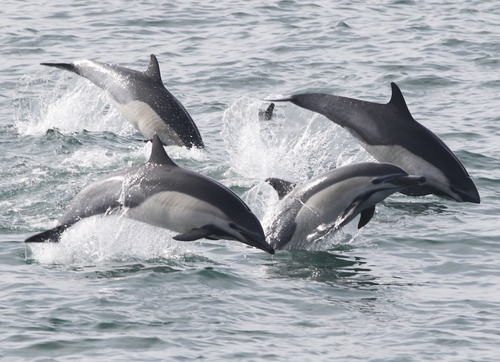
The Panglobal Common Dolphin is easily identified by its distinctive colouring: a striking yellow and grey hourglass pattern on each side of its body, unique among dolphins. It lives in groups that can gather in aggregations of several hundred or even thousands of individuals, forming some of the largest social concentrations known among marine mammals. It is one of the most widespread cetaceans on the planet, found in temperate and tropical waters of almost all oceans. However, some of its coastal populations and those in semi-enclosed seas are in a much more precarious situation than the species as a whole.
Panglobal Common Dolphin is a small to medium-sized dolphin. It has an hourglass-shaped colour pattern on its flanks, golden yellow towards the front and grey towards the back. Its back is dark and its belly white. Its elongated face features a beak clearly separated from the forehead.
It is distinguished from other similarly sized dolphins by this very distinctive colour pattern, which is unique among cetaceans in its range.
The Panglobal Common Dolphin does not leave tracks in the conventional sense. However, its presence is detected by very active groups on the surface, frequent leaps out of the water, and a tendency to approach boats to bow-ride. Underwater, it emits a wide variety of echolocation whistles and clicks, used both for group hunting and for maintaining social cohesion. In feeding areas, it can be observed hunting in groups, herding shoals of fish towards the surface in a coordinated manner.
Temperate and tropical waters of the continental shelf and open sea, from the surface to several hundred metres deep on dives. Very widely distributed throughout the Atlantic, Pacific, Indian Oceans, and semi-enclosed seas such as the Mediterranean and Black Sea.
The Panglobal Common Dolphin feeds on small schooling fish and squid, hunting them in groups by coordinating the herding of prey schools near the surface.
Highly social, it forms groups of highly variable size, from tens to several thousand individuals in productive feeding areas. Its social structure is fluid, with individuals frequently changing groups.
It does not undertake strict migrations, but makes wide-ranging movements following prey availability.
The Panglobal Common Dolphin maintains numerous and stable populations throughout most of its global distribution range. However, several coastal and semi-enclosed sea populations, such as those within the Mediterranean Sea, have suffered significant declines in recent decades. These are assessed separately, with a much more concerning status.
Bycatch in fishing gear, overfishing of its prey in some regions, pollution and coastal habitat degradation in the more local and isolated populations.
See all species accounts for even-toed ungulates · Full species index
Mammaling is a free app for logging the mammals you find. You record a sighting in a moment — even if it's just a track — your life list grows, and the record becomes available to scientific and conservation projects.
It runs on your phone with nothing to install. If you like, it adds to your home screen like any other app.
Open Mammaling