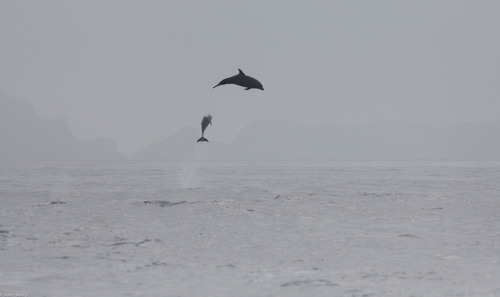
The Common Bottlenose Dolphin is probably the most familiar cetacean to the general public, often featuring in aquariums and documentaries. However, wild populations have a social life and problem-solving abilities far more sophisticated than their popular image suggests.
Some populations have developed tool use, such as carrying sea sponges on their rostrum to protect their snout while foraging for food on sandy bottoms. This is a cultural tradition passed from mothers to young.
The Common Bottlenose Dolphin lives in coastal and oceanic waters almost worldwide. However, this single name actually conceals very distinct populations and forms, some of which are in a much more delicate conservation situation than the species as a whole.
A robust, medium-large Common Bottlenose Dolphin, uniformly grey, darker on the back and lighter on the belly. It has a short beak, well-differentiated from its bulging forehead (melon).
It differs from other dolphins in the region by its more massive body and more uniform colouring. It lacks the contrasting band or spot patterns of species such as the Striped Dolphin or the Short-beaked Common Dolphin.
It leaves no tracks on land; it is detected by its surface behaviour, with frequent leaps and tail slaps, and by its curious approach to boats and bow-riding. Underwater, it emits characteristic, individual whistles. Each individual maintains a unique 'signature whistle' throughout its life, which other group members recognise. In coastal areas, the Common Bottlenose Dolphin can be observed hunting in very shallow water, sometimes partially stranding on sandbanks to corral fish against the shore.
Habitat is highly varied. It occupies shallow coastal waters, bays, estuaries and open sea, from the surface to several hundred metres deep depending on the population.
It is distributed in temperate and tropical waters of almost all the world's oceans. Coastal populations are strongly tied to a specific territory, while oceanic populations are much more dispersed.
It feeds on a wide variety of fish, squid and crustaceans, caught using highly varied hunting techniques depending on the population, ranging from open-sea pursuit to cooperative herding of fish shoals in shallow waters.
Highly social, the Common Bottlenose Dolphin lives in fluid groups that change frequently, with complex and lasting social relationships between some individuals. Different populations have developed culturally transmitted hunting and tool-use traditions, and some coastal populations show strong fidelity to a small territory throughout their lives.
The Common Bottlenose Dolphin maintains numerous and stable populations throughout most of its global distribution. However, several coastal populations and specific subspecies, assessed separately, are in a much more precarious situation. This is due to their small size and direct exposure to human activity in coastal areas.
Bycatch in fishing gear, degradation of coastal habitats, pollution by persistent compounds, and, in some regions, direct conflict with artisanal fisheries.
See all species accounts for even-toed ungulates · Full species index
Mammaling is a free app for logging the mammals you find. You record a sighting in a moment — even if it's just a track — your life list grows, and the record becomes available to scientific and conservation projects.
It runs on your phone with nothing to install. If you like, it adds to your home screen like any other app.
Open Mammaling