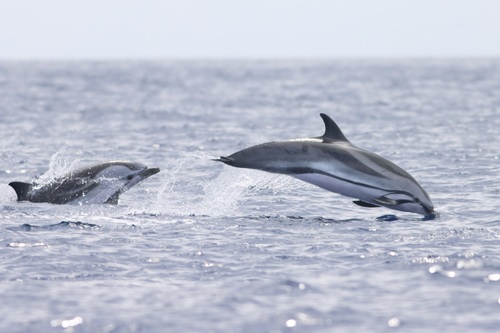
The Striped Dolphin is one of the most acrobatic dolphins, capable of a spectacular sequence of leaps, spins and somersaults out of the water during group movements. This behaviour made it a historical favourite in dolphinarium shows before its capture was restricted. It lives in very large, cohesive groups that can exceed a hundred individuals. It is recognised by striking dark bands that run along its body from the eye to the flank, as if several lines had been painted with a brush. In the Mediterranean, at the end of the last century, it was involved in one of the best-documented episodes of mass cetacean mortality. This was caused by a viral outbreak that decimated a significant portion of the basin's population.
The Striped Dolphin is a small to medium-sized dolphin with a dark greyish-blue back and a white or pinkish belly. Its most characteristic feature is one or two dark, narrow bands running along the flank from the eye to the anus. It differs from the Common Dolphin by the absence of the hourglass pattern and by these very marked longitudinal bands. It differs from the Bottlenose Dolphin by its distinctly smaller size and finer beak.
The Striped Dolphin leaves no observable tracks on land. It is detected by large, very active groups on the surface, which perform frequent acrobatic leaps and tend to approach boats at high speed. Underwater, it emits whistles and echolocation clicks, used for group hunting and social cohesion, which are detectable with a hydrophone. In productive feeding areas, it can be observed forming large aggregations alongside other dolphin species and seabirds, all attracted by the same prey school.
Warm and tropical open ocean waters, especially in areas of continental slope and deep ocean, rarely very close to the coast except where the continental shelf is narrow. Distributed throughout the Atlantic, Pacific, and Indian Oceans and semi-enclosed seas such as the Mediterranean.
It feeds on mid-water and deep-water fish and squid, caught by diving to depths exceeding two hundred metres.
Highly social, it forms numerous groups that can exceed a hundred individuals, with a fluid social structure and wide-ranging movements following prey availability in deep waters.
It maintains numerous and stable populations throughout most of its global home range. The Mediterranean Sea population suffered mass mortality in the late 20th century due to a morbillivirus outbreak, from which it has partially recovered in subsequent decades.
Bycatch in drift nets, pollution by persistent compounds which accumulate in fat and can exacerbate the impact of viral outbreaks, and degradation of deep-water feeding habitats.
See all species accounts for even-toed ungulates · Full species index
Mammaling is a free app for logging the mammals you find. You record a sighting in a moment — even if it's just a track — your life list grows, and the record becomes available to scientific and conservation projects.
It runs on your phone with nothing to install. If you like, it adds to your home screen like any other app.
Open Mammaling