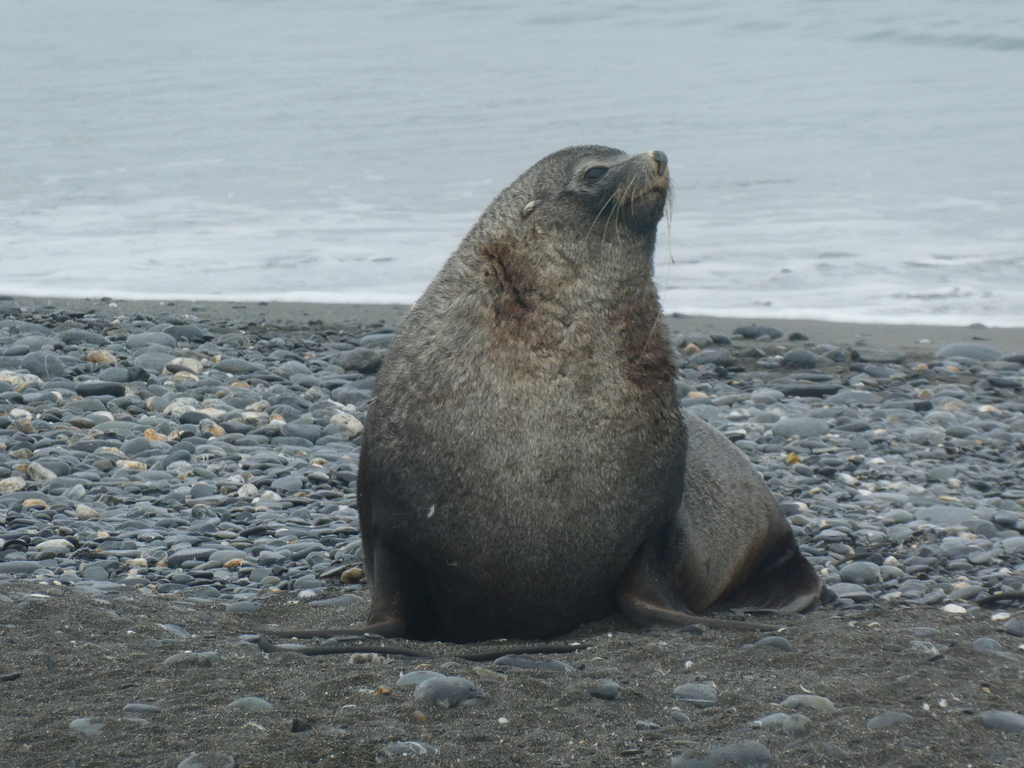
A century ago this species was on the brink of extinction, hunted almost to nothing for its fur. Its subsequent recovery, to more than two million individuals, became one of the great marine conservation successes of the twentieth century. That success has been reversed in barely a decade: a shortage of krill, its almost exclusive food, has sunk the population by more than half since 1999, and in 2026 the species was officially classed as Endangered, one of the clearest signs of how climate change is transforming the Antarctic ecosystem from its base.
Dense fur, grey-brown to almost black in males, paler on the chest, with visible, well-developed external ears, unlike true seals. Males are notably larger than females and develop a thick, muscular neck. It differs from the Subantarctic Fur Seal in lacking the yellowish face and chest characteristic of that species.
Unlike true seals, it can tuck its hind flippers under the body and walk with some agility on land, leaving a trail of more defined tracks, with marks of the five claws of the fore flippers. Breeding colonies leave areas of crushed vegetation and disturbed ground on the pebble beaches of the subantarctic islands, with a strong smell and a large amount of droppings.
Subantarctic islands, with by far the main colony on South Georgia, and the surrounding waters of the Southern Ocean where it feeds near the surface.
Almost exclusively Antarctic krill, supplemented to a lesser extent with fish and squid. This near-total dependence on a single prey makes it especially vulnerable to changes in krill availability.
Forms large, very dense and noisy breeding colonies on the coast, with territorial males that defend a group of females. Makes relatively short feeding trips while rearing pups, but may travel long distances at sea for the rest of the year.
The world population, estimated at more than two million mature individuals in 1999, had fallen to under a million by 2025, a decline of over 50% that led the IUCN to reclassify the species from Least Concern to Endangered in 2026. The main cause is the shortage of krill brought on by warming and sea-ice loss in the South Atlantic, which pushes krill into colder, deeper waters. To this are added competition from recovering populations of large whales and predation by Killer Whales and Leopard Seals.
Krill shortage from warming of the Southern Ocean and loss of sea ice, ageing of the breeding population owing to the continued reproductive failure of pups, and growing competition with recovering baleen whales for the same resource.
See all species accounts for carnivores · Full species index
Mammaling is a free app for logging the mammals you find. You record a sighting in a moment — even if it's just a track — your life list grows, and the record becomes available to scientific and conservation projects.
It runs on your phone with nothing to install. If you like, it adds to your home screen like any other app.
Open Mammaling