It was so close to extinction that it came to disappear twice: first at the end of the nineteenth century after decades of intensive commercial hunting for leather trade, and again at the beginning of the twentieth century, until in the fifties it was confirmed the survival of a small group on a remote island in the Mexican Pacific. From that handful of survivors, the species has recovered to several tens of thousands of individuals, one of the most notable cases of recovery among the pinnípedos of the world from such a reduced founding population. It lives in temperate waters of the eastern Pacific, where it reproduces almost exclusively on the island that gave it shelter during its low point, although in recent decades it has begun to colonize again other islands of its ancient distribution area.
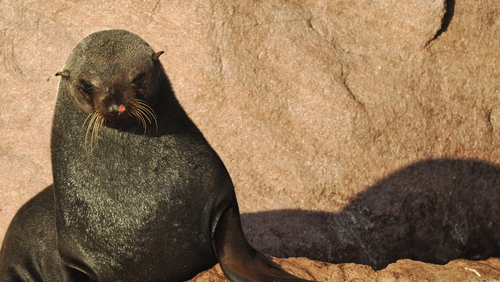
A medium-sized pinnípedo, dark brown to black-colored fur, relatively sharp fox and small and visible external ears. It differs from the California sea wolf, with which it shares part of its area, by its darker and dense fur, its sharpest fox and its slightly smaller size.
It does not leave an individual footprint as a terrestrial mammal; in the sand or rock of its rest beaches it leaves a trail of drag similar to that of other otarids, with lateral marks of the extremities when moving partially backed by the back. colonies are recognized for concentrating in sharp rocky zones and coastal caves, unlike the California marine wolf, who prefers more open beaches, and for more acute and less serious vocalizations than those of the latter.
Temperate coastal waters of the eastern Pacific, with sharp rocky coast and caves for rest and breeding. Distributed mainly around the island of Guadalupe, opposite the coast of the Mexican Pacific, with incipient colonies on other islands in the region.
Carnivorous, feeds on fish and calamar of medium and deep waters.
It forms reproductive colonies in which males defend territories with several females.It is more solitary and more coastal and rocky than other otáridos of its area, preferring shelters in coves and sharp cracks.
Its population has recovered remarkably from the historical lows of the early 20th century to several tens of thousands of individuals, with a general trend in the rise and colonization of new islands in recent decades.
Low genetic diversity inherited from the historical bottle neck, and risk of plot in fishing arts and competition with commercial fishing activity.
See all species accounts for carnivores · Full species index
Mammaling is a free app for logging the mammals you find. You record a sighting in a moment — even if it's just a track — your life list grows, and the record becomes available to scientific and conservation projects.
It runs on your phone with nothing to install. If you like, it adds to your home screen like any other app.
Open Mammaling