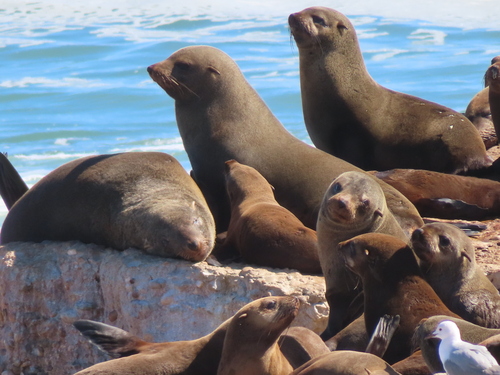
Forms some of the densest mammal colonies on the planet, with tens of thousands of individuals crowded onto a handful of islands and rocky beaches in southern Africa each breeding season. It shares its species with a very similar-looking Australian subspecies on the other side of the Indian Ocean, a striking example of a disjunct distribution between two continents.
Robust otariid, with males much larger than females (up to 360 kg against 120 kg), fur from dark brown to greyish, and males with a mane of longer hair around the neck and a pronounced forehead. It is distinguished from true seals by its visible external ears and by being able to turn the hind flippers forward to move on land.
Leaves flipper drag marks on the sand near resting areas, very different from the tracks of a land mammal. Breeding colonies leave areas of heavily compacted ground with a strong characteristic smell, owing to the concentration of thousands of individuals.
Rocky and sandy coasts and islands off southern Africa (Cape subspecies) and south-eastern Australia (Australian subspecies), foraging in coastal and shelf waters.
Opportunistic fish-eater: pelagic fish, squid and occasionally seabirds, caught in dives that can reach considerable depths.
Highly gregarious, forming massive breeding colonies where males establish and defend territories through displays and fights. After mating there is a delayed implantation of about 4 months, followed by an active gestation of about 8 months, so that birth falls at the same time of year every year.
Population stable or increasing in recent generations since the end of historic commercial hunting.
Entanglement in fishing gear and marine litter, competition with commercial fishing for the same resources, and occasional mortality from population control in areas of conflict with the fishing industry.
See all species accounts for carnivores · Full species index
Mammaling is a free app for logging the mammals you find. You record a sighting in a moment — even if it's just a track — your life list grows, and the record becomes available to scientific and conservation projects.
It runs on your phone with nothing to install. If you like, it adds to your home screen like any other app.
Open Mammaling