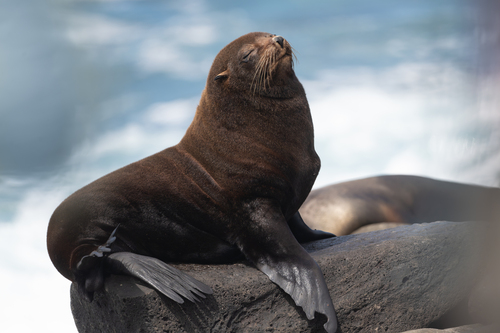
The smallest of all the world's otariids and, alongside the Galapagos Sea Lion, one of only two pinnipeds that live permanently in equatorial waters—a remarkable physiological feat for an animal whose lineage evolved in much colder seas. To survive the tropical heat it has become largely nocturnal, resting in caves and beneath shaded lava overhangs during the day. It emerges to feed mostly at night, when its deep-water prey ascends closer to the surface. It rears its young over an exceptionally long lactation period of up to two or three years, the longest of any otariid. This strategy leaves it especially vulnerable when El Niño events warm the sea and abruptly reduce food availability.
A small otariid, the smallest of its family, with greyish-brown to blackish fur, a short snout and visible external ears that distinguish it from true seals. It is confused with the larger Galapagos Sea Lion, which has a longer snout and more uniform brown colouring; its distinctly smaller size and darker coat are the most reliable features for telling them apart.
It leaves no tracks and signs in the usual sense on volcanic rock, although in sandy areas it may leave body-drag marks with flipper prints to the sides. It rests in coastal caves and beneath shaded lava overhangs during the day, a behaviour that sets it apart from the Galapagos Sea Lion, which is more visible on open beaches in full sunlight. Its presence is revealed by high-pitched calls between mothers and young in breeding colonies, and by aggregations of individuals in shaded, rocky coastal areas where it rests during the hottest hours.
Volcanic rocky coasts with caves and shaded overhangs, in equatorial tropical waters. Endemic to the Galápagos Archipelago, with a distribution strictly restricted to these islands and no natural presence outside them.
Feeds on mesopelagic fish and squid, caught during nocturnal dives when these deep-water prey species ascend closer to the surface.
Markedly nocturnal, an unusual behaviour among otariids that allows it to avoid the extreme heat of the equatorial day. It has the longest known lactation period of any otariid, lasting up to two or three years, and is highly sensitive to sea-warming El Niño events, which can cause mass mortality of young and adults through food shortages.
Populations suffer recurrent mass mortality during severe El Niño events, which can reduce the population by a very high percentage within a few months. Subsequent recovery is slow given its low reproductive rate, and the long-term trend is considered to be in decline.
Sea-warming events associated with El Niño, which are becoming increasingly frequent and intense with climate change; bycatch in fishing gear; and diseases introduced by domestic species on the islands.
See all species accounts for carnivores · Full species index
Mammaling is a free app for logging the mammals you find. You record a sighting in a moment — even if it's just a track — your life list grows, and the record becomes available to scientific and conservation projects.
It runs on your phone with nothing to install. If you like, it adds to your home screen like any other app.
Open Mammaling