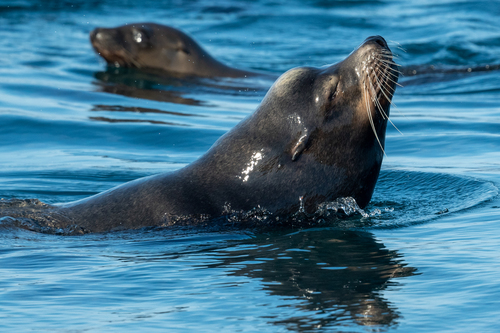
This is the animal that almost everyone recognises as the "trained seal" of aquariums and circuses, although it is not actually a seal but a sea lion—a group of pinnipeds with visible external ears and the ability to rotate their hind limbs forwards to move on land with an agility no true seal possesses. Adult males develop a very prominent bony crest on top of the head and a coat that darkens to black, much more marked than in females, with which they form very noisy breeding colonies on rocky beaches of the American Pacific. Its vocalisation—a deep, repetitive bark—is so characteristic that it has been used for decades as generic "zoo seal" background audio in film and television, almost always without viewers knowing it is actually a sea lion. It is a remarkably flexible diver, capable of both short, shallow dives in search of prey and occasional descents of several hundred metres.
Medium-large pinniped, with visible external ears unlike true seals, a dark brown to black coat in the adult male and paler in the female, and a prominent bony crest on the adult male's forehead. It differs from the true seals in its range by those external ears and by its ability to support itself on its hind limbs to move across land, and from Steller's Sea Lion by its distinctly smaller size and darker colouring.
It leaves no individual footprint track like a terrestrial mammal; on the sand of haul-out beaches it leaves a drag mark with lateral flipper impressions, differing from the continuous drag mark of a true seal by showing more defined points of support thanks to its ability to push itself along with its hind limbs. Colonies are identified by striking aggregations on rocky beaches or artificial piers, with a very characteristic deep, repetitive bark audible from a great distance, and half-eaten fish remains near frequented haul-out sites.
Temperate and subtropical coastal waters, with rocky or sandy beaches and artificial piers for hauling out. Distributed along the American Pacific coast from central Mexico to south-western Canada, including the Gulf of California.
Carnivorous, feeding on fish and squid caught during dives that can exceed 250 m in depth, although most are much shallower.
Forms very large, noisy colonies on breeding beaches, where males defend territories containing harems of several females. Highly sociable outside the breeding season, hauling out in large groups on beaches and piers, it has shown a remarkable ability to adapt to human presence, colonising harbours and artificial docks.
Its populations are considered to be increasing or stable across most of its range since the end of historic commercial hunting, showing a remarkable recovery over the course of the 20th century.
Conflict with fisheries through resource competition and bycatch in fishing gear, alongside periodic episodes of poisoning from toxic algal blooms.
See all species accounts for carnivores · Full species index
Mammaling is a free app for logging the mammals you find. You record a sighting in a moment — even if it's just a track — your life list grows, and the record becomes available to scientific and conservation projects.
It runs on your phone with nothing to install. If you like, it adds to your home screen like any other app.
Open Mammaling