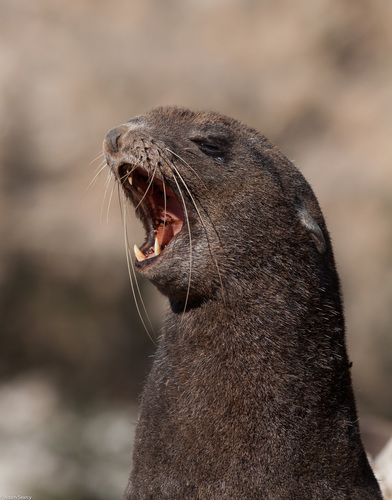
It has the densest fur of any mammal in the world, with over 300,000 hairs per square centimetre in some body areas. During the 18th and 19th centuries, this trait made it one of the most heavily hunted animals for commercial fur trading across the North Pacific, driving its populations to the brink of collapse.
It breeds on a few very specific islands in the North Pacific, where males, much larger than females, defend harems of dozens of females on crowded beaches for a few summer weeks. This size difference between the sexes is one of the most pronounced of any marine mammal. The Northern Fur Seal spends the rest of the year in the open ocean, travelling thousands of kilometres to feed in waters far removed from its breeding colonies.
A medium-sized otariid with marked sexual dimorphism. The male, much larger than the female, has a very muscular neck and shoulders and dark brown to almost black fur. The female is significantly smaller and greyish. It is distinguished from other North Pacific otariids, such as Steller's Sea Lion, by its clearly smaller size and shorter, more pointed muzzle.
Flipper tracks show five claw marks, but these are difficult to find except on breeding beaches where the species gathers in summer. Across the sand or rock of breeding colonies, it leaves body-drag marks between resting areas and the water. Its presence is revealed above all by vast concentrations of individuals and the constant noise of vocalisations at breeding colonies on a few very specific islands during summer—a highly characteristic marine wildlife spectacle in these locations.
Oceanic waters of the North Pacific for most of the year, with breeding concentrated on a few specific islands, notably the Pribilof Islands in Alaska and the Commander Islands in Russia. During the rest of the year, it undertakes migratory movements of thousands of kilometres between breeding colonies and oceanic feeding areas much further south.
Feeds on pelagic fish and squid, caught during relatively deep dives on long oceanic journeys outside the breeding season.
Forms very dense, noisy breeding colonies on a few North Pacific islands. There, males defend harems of several dozen females through displays and fights for a few summer weeks. Outside the breeding season it is highly pelagic, spending most of the year in open water undertaking long migratory movements.
Populations have suffered a very marked decline since the mid-20th century. The causes are not fully understood, but may include changes in prey availability and bycatch in fisheries. Although commercial fur hunting ended decades ago, population recovery has been limited at several main colonies.
Historical and current bycatch in fishing gear, competition for prey with commercial fisheries in the North Pacific, and changes in prey availability linked to oceanographic and climate variations.
See all species accounts for carnivores · Full species index
Mammaling is a free app for logging the mammals you find. You record a sighting in a moment — even if it's just a track — your life list grows, and the record becomes available to scientific and conservation projects.
It runs on your phone with nothing to install. If you like, it adds to your home screen like any other app.
Open Mammaling