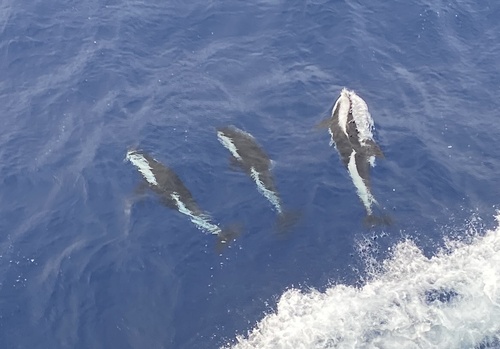
The only small dolphin regularly seen south of the Antarctic Convergence, famous among crews crossing the Drake Passage for accompanying ships with acrobatic leaps in some of the coldest and most remote waters on the planet.
Small and robust-bodied, with a very distinctive black and white colour pattern that resembles an hourglass and gives it its name; it has a large dorsal fin curved backwards, varying in shape between individuals from erect to strongly hooked.
Antarctic and Subantarctic circumpolar oceanic waters, with sightings concentrated mainly between South America and Macquarie Island, near the Antarctic Convergence, in waters between 0.6 and 13 °C.
Piscivorous and teuthophagous; it feeds on fish and cephalopods from cold Antarctic and sub-Antarctic waters.
A pelagic species of offshore waters, frequently sighted accompanying vessels crossing the Drake Passage; considered a taonga (a species of cultural value) by the Māori of New Zealand, where it occasionally reaches the northern limit of its distribution.
Species with a wide circumpolar distribution and classified as Least Concern, with an estimated population of over 140,000 individuals and no identified threats.
No major threats have been identified on a global scale; it is a little-studied species due to the remoteness of its habitat.
See all species accounts for even-toed ungulates · Full species index
Mammaling is a free app for logging the mammals you find. You record a sighting in a moment — even if it's just a track — your life list grows, and the record becomes available to scientific and conservation projects.
It runs on your phone with nothing to install. If you like, it adds to your home screen like any other app.
Open Mammaling