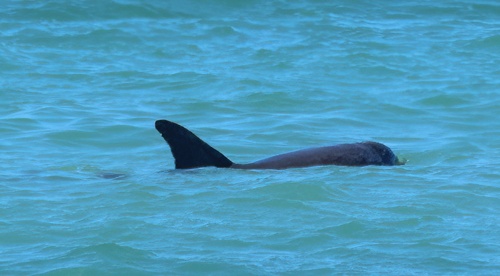
One of the least known and most rarely sighted delphinids in the world, the Pygmy Killer Whale is so scarce in records that much of what is known about its behaviour comes from the few individuals kept in captivity. In captivity, it displayed a temperament notably more aggressive than that of other similarly sized dolphins, which earned it its common name.
Despite its common name, Pygmy Killer Whale, it is not closely related to the Killer Whale. Instead, it is a warm-water delphinid of intermediate size between a typical dolphin and a False Killer Whale.
It lives almost exclusively in open ocean, far from the coast. This, combined with its scarcity and elusive behaviour, makes sighting it in the wild one of the most coveted observations among cetacean watchers worldwide.
A small to medium-sized dolphin with a slender black or dark grey body and a slightly darker dorsal cape. Its head is rounded, without a distinct beak. Very characteristic white lips contrast with the rest of its dark face.
It can be confused with the False Killer Whale, which is larger and lacks these white lips. The Melon-headed Whale, with its more conical head and less marked lip contrast,
It leaves no tracks on land; it is detected by a low blow, followed by a rapid emergence of its back with a high, falcate dorsal fin, similar to that of a medium-sized dolphin. Its surface behaviour is more discreet and less acrobatic than that of other dolphins, and it rarely approaches boats for extended periods. The vast majority of records for the Pygmy Killer Whale come from isolated strandings or occasional sightings in open water. This in itself reflects how infrequently its presence is detected.
Deep, warm oceanic waters, tropical and subtropical, generally far from the coast.
Widely distributed in warm waters worldwide, it is rarely recorded directly due to its elusive behaviour and preference for open sea.
It feeds on deep-water fish and squid, caught by diving in open water.
The Pygmy Killer Whale lives in variable-sized groups, usually numbering several tens of individuals. Its social structure in the wild is poorly understood. Its behaviour observed in captivity is more aggressive than that of other similarly-sized dolphins. This has not been thoroughly compared with field data due to the scarcity of sightings.
Due to its elusive behaviour and preference for oceanic waters far from the coast, direct population data for the Pygmy Killer Whale is almost entirely lacking. This prevents a reliable assessment of its global population trend, although no signs of widespread decline have been detected in the best-studied areas.
Bycatch in deep-sea fishing gear, pollution from persistent compounds accumulated in its blubber, and underwater acoustic pollution that can interfere with its echolocation in the open sea.
See all species accounts for even-toed ungulates · Full species index
Mammaling is a free app for logging the mammals you find. You record a sighting in a moment — even if it's just a track — your life list grows, and the record becomes available to scientific and conservation projects.
It runs on your phone with nothing to install. If you like, it adds to your home screen like any other app.
Open Mammaling