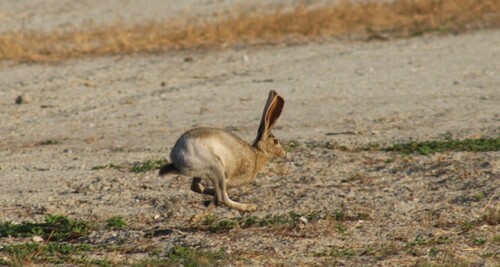
For more than a century this hare of the Gulf of Mexico coastal plain was taken to be no more than a local population of the black-tailed jackrabbit, until genetic analysis in 2019 showed it to be a species in its own right, more closely related to the Tehuantepec jackrabbit than to its supposed cousin. Between its original description in 1898 and its first confirmed photograph, more than a hundred years passed without a single verified record, feeding the fear that it had quietly gone extinct. Only through incidental camera-trapping in 2014 and 2016, formally confirmed in a 2022 study, did we learn that the species was still alive in a very small corner of north-eastern Mexico. It is one of the least known and most threatened hares on the continent, rediscovered almost by accident.
It is externally very similar to Lepus californicus, of which it was considered a subspecies for decades, so reliable field identification rests above all on locality: it is known with certainty only from the coastal plain of southern Tamaulipas, the northern tip of Veracruz and eastern San Luis Potosí. It shares the large size, long ears and powerful hind legs characteristic of the genus Lepus. External morphology does not reliably separate it from L. californicus, which has colonised much of its former range, without genetic data.
No field signs have been described specifically for this species that would reliably separate it from those of Lepus californicus, with which it shares habitat in places: elongated hind tracks landing well ahead of the front ones, and droppings as round pellets of plant fibre, as in other North American hares. With no diagnostic sign to go on, any sighting or track attributed to this species outside its confirmed range in the Tamaulipan coastal scrub should be treated with caution.
Restricted to the Tamaulipan thorn scrub (mezquital) of the Gulf of Mexico coastal plain, in southern Tamaulipas, the northern tip of Veracruz and eastern San Luis Potosí, at low elevations near the coast.
It feeds on the grasses and herbaceous plants of the coastal scrub, presumably much as other hares of the genus Lepus do, although no specific dietary studies have been published.
Very little is known directly about its behaviour, as it had never been studied alive until the recent photographic records. By phylogenetic proximity it is assumed to be crepuscular to nocturnal and solitary, like other hares in the genus.
As a species rediscovered only recently after a century without records, it has not yet been assessed by the IUCN. Its known range is extremely small, which raises serious questions about its vulnerability that have yet to be formally addressed.
The conversion of the coastal Tamaulipan scrub to farmland and pasture, together with possible competition from or replacement by Lepus californicus, which has colonised much of its former range, are the clearest threats to a species with such a restricted distribution.
See all species accounts for rabbits and hares · Full species index
Mammaling is a free app for logging the mammals you find. You record a sighting in a moment — even if it's just a track — your life list grows, and the record becomes available to scientific and conservation projects.
It runs on your phone with nothing to install. If you like, it adds to your home screen like any other app.
Open Mammaling