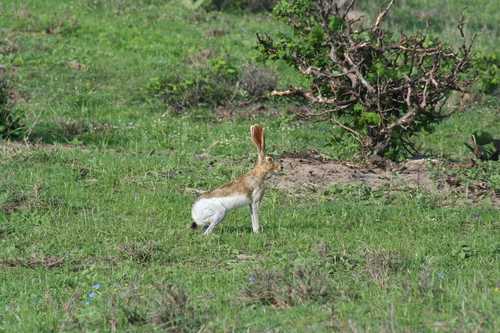
It is the American hare with the smallest home range of all, confined to a handful of coastal grassland localities around the lagoons of the Isthmus of Tehuantepec in southern Mexico—a territory so small that the entire species could disappear in a single large-scale adverse event. It is distinguished from other Mexican hares by the pale yellowish throat that gives it its name, which is visible even from a distance when the animal stands alert with its neck erect. The Tehuantepec Jackrabbit lives in open grassland dotted with scattered vegetation near the South Pacific coast, a habitat that has undergone intense transformation from livestock farming and agriculture in recent decades. It is one of the most threatened hares in the Americas, and its survival depends almost entirely on preserving the last remaining fragments of coastal grassland it still occupies.
A medium-sized hare with greyish-brown fur on its back, a very characteristic pale yellowish throat, long dark-tipped ears, and long, powerful hind legs. It differs from other hares in the region by this highly distinctive yellowish throat and its extremely restricted distribution in the Isthmus of Tehuantepec.
Track with 4 toes on the hind foot, much longer than the front track, 9-11 cm long, showing the characteristic hare-bounding tracks and signs: two hind tracks aligned in front of the two front tracks. Rounded, fibrous droppings 1-1.2 cm in diameter, left in small scattered groups across the grassland. It leaves small depressions in the ground (forms) beneath tall grass tussocks where it rests during the day, typical of hares, as well as clear runs marked by repeated use of the same routes between grassland patches.
Coastal open grassland with scattered vegetation, in lowlands near the coast. Endemic to a very small area around the lagoons of the Isthmus of Tehuantepec, in the state of Oaxaca, southern Mexico, with no natural presence outside this region.
Herbivorous, it feeds on grass and low herbs in coastal grassland, its diet varying according to seasonal availability.
Primarily solitary, although it may form small, loose groups in areas with good grass availability. Nocturnal and crepuscular, it does not migrate, remaining within a relatively fixed territory in the coastal grassland it inhabits.
Its total population is estimated at just a few thousand individuals spread across a few very small localities, in continuous decline due to the transformation of coastal grassland. Conservation efforts are focused on the localities with the highest known density.
Conversion of native coastal grassland to farmland and livestock pasture, unregulated hunting, and the species' extreme geographic restriction, which leaves it vulnerable to any adverse local event such as fires or hurricanes.
See all species accounts for rabbits and hares · Full species index
Mammaling is a free app for logging the mammals you find. You record a sighting in a moment — even if it's just a track — your life list grows, and the record becomes available to scientific and conservation projects.
It runs on your phone with nothing to install. If you like, it adds to your home screen like any other app.
Open Mammaling