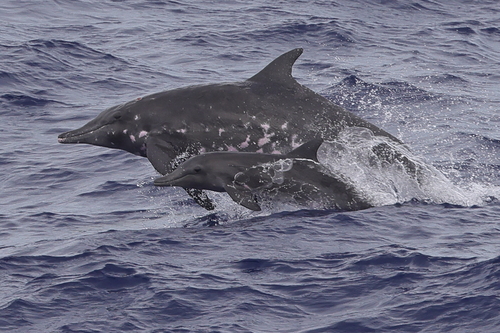
The Rough-toothed Dolphin's head is so pointed, with no break between the forehead and beak, that its profile is more reminiscent of a marine reptile than a typical dolphin. This silhouette is unmistakable among delphinids, which almost always have a bulging forehead clearly differentiated from the beak. Its skin is often speckled with pink, white, and cream spots that increase with age and rubbing against other
A medium-sized dolphin with a slender dark grey body, marked with pink, white and cream spots that increase with age. Its conical head lacks the characteristic melon break of most dolphins, presenting a continuous profile from forehead to beak. The Rough-toothed Dolphin differs from all other dolphins in its area precisely because of this head without a melon break. This is a unique trait among delphinids, making it unmistakable in good visibility sightings.
The Rough-toothed Dolphin leaves no tracks on land; it is detected by a low blow, followed by the emergence of its back with a high, falcate dorsal fin. Its surface behaviour includes occasional leaps and a moderate tendency to approach boats, though with less acrobatic enthusiasm than other oceanic dolphins. Underwater, it emits whistles and echolocation clicks used for social cohesion and group hunting. It is often observed associated with other deep-water cetacean species.
Deep oceanic tropical and warm-temperate waters worldwide, generally far from the coast over the continental slope. Widely distributed throughout the Atlantic, Pacific, and Indian Oceans, with documented presence in most warm seas worldwide.
It feeds on mesopelagic fish and squid, captured by group hunting in deep waters.
Social, the Rough-toothed Dolphin lives in variable-sized groups, from a few individuals to several tens, sometimes associated with other oceanic dolphin species. Its reproductive and social biology is less known than that of other dolphins that are more coastal and more easily studied.
A lack of sufficient population data across much of its oceanic range prevents an accurate understanding of global population trends, although no signs of widespread decline have been detected in better-studied areas.
Bycatch in high-seas fishing gear, pollution from persistent compounds accumulated in its blubber, and underwater acoustic pollution that can interfere with its echolocation in deep waters.
See all species accounts for even-toed ungulates · Full species index
Mammaling is a free app for logging the mammals you find. You record a sighting in a moment — even if it's just a track — your life list grows, and the record becomes available to scientific and conservation projects.
It runs on your phone with nothing to install. If you like, it adds to your home screen like any other app.
Open Mammaling