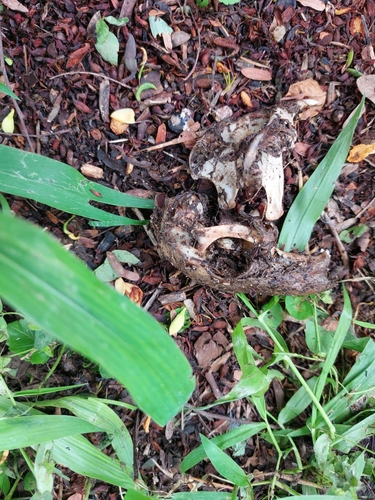
Living exclusively in the Marías Islands archipelago off Mexico's Pacific coast, the Tres Marías Cottontail has developed its own traits after generations of complete isolation from other continental cottontails of its genus. Like many small island mammals, its entire population depends on the vegetated area available on a handful of islands. For decades, these islands also housed a federal penal colony, whose activity transformed much of the
A medium-sized rabbit with greyish-brown fur, moderately long ears, and a short white tail visible when it flees, like other American cottontails. It differs from other continental cottontails by its exclusive distribution to the Marías Islands archipelago, with no overlap with any mainland population.
Tracks show 4 toes on each foot. Hind tracks are noticeably more elongated, 6-8 cm long, with the characteristic hopping pattern of rabbits: two hind tracks aligned in front of the two fore tracks. Droppings are rounded and fibrous, 1-1.3 cm long, left in small groups scattered through feeding areas. It leaves small depressions in the ground (forms) under dense vegetation where it rests during the day, and runs marked by repeated use of the same routes between patches of vegetation.
Dry tropical forest and coastal scrub vegetation of the Marías Islands, in island lowlands. Endemic to this archipelago off the Pacific coast of Nayarit state, Mexico, with no natural presence outside these islands.
Herbivorous, it feeds on grass, leaves and tender bark from the vegetation on the islands where it lives.
Solitary or in small, loose groups, the Tres Marías Cottontail is mainly nocturnal and crepuscular, remaining crouched and alert under dense vegetation for most of the day. It does not migrate, maintaining a relatively fixed territory within the island it occupies.
Its populations are considered to be in decline due to the historical transformation of the island habitat, linked to human activity from the former penal colony, and the introduction of invasive species on some of the islands.
Introduction of cats, dogs and other invasive species on the Marías Islands, and alteration of the island habitat by human activity and infrastructure.
See all species accounts for rabbits and hares · Full species index
Mammaling is a free app for logging the mammals you find. You record a sighting in a moment — even if it's just a track — your life list grows, and the record becomes available to scientific and conservation projects.
It runs on your phone with nothing to install. If you like, it adds to your home screen like any other app.
Open Mammaling