
Illustration generated with artificial intelligence from reference sources and reviewed by the team. Use it as a guide, not as a definitive identification key: it may contain errors in anatomical details such as the number of toes, claw marks or the scale. If something looks off, write to us at [email protected]: corrections from people who know the field are what keep improving these plates.
If you had to choose a single animal to represent a mammal's capacity for survival, the Red Fox would be it. The Red Fox hunts in the same forests its ancestors did thousands of years ago. It also forages in bins in large cities, neither environment proving particularly hostile. It is the wild canid with the widest global distribution, naturally present across almost the entire northern hemisphere. It has a little-known trick: it can hear a rodent moving under the snow and calculate the precise distance to jump, plunging its snout exactly where the rodent is.
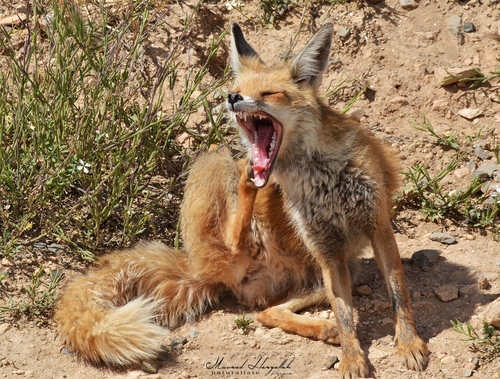
A small to medium-sized canid with reddish-orange fur, a white belly, throat, and tail tip, and black legs and backs of the ears. The tail is long and very bushy. It has vertical pupils, an uncommon trait among canids. It can be confused with the Golden Jackal where both species occur, but the latter has a shorter tail without a white tip.
Oval and elongated track, narrower than that of a similarly sized dog, 4-5 cm long, with four toes, distinct claws, and a trilobed plantar pad.
Droppings are elongated and spirally twisted, 5-10 cm long, containing hair, bones, and fruit remains. They have a strong musky odour and are deposited conspicuously at crossroads or on stones as a territorial mark.
It uses its own burrows or those of other animals (often badger setts), and buries leftover prey remains.
Highly adaptable species: forest, scrub, agricultural land, and urban and peri-urban environments. Present across almost the entire Northern Hemisphere (Europe, Asia and North America) and in North Africa, from sea level to high mountains. Introduced to Australia, where it is an invasive species.
Opportunistic omnivore: small rodents, birds, insects, fruit and carrion, and in urban environments also human-derived refuse. It hunts mainly by stalking and scent.
Solitary or in small family groups, with territory marked with urine and droppings. Oestrus occurs in winter in temperate zones of the northern hemisphere, and the female raises a single annual litter of 4-6 young.
It is one of the carnivores with the widest global distribution. Its populations remain stable or are expanding across most of its range. This includes a notable colonisation of urban environments in Europe and North America in recent decades.
Roadkill, human control through hunting or as a pest in some regions, and sarcoptic mange. It faces no significant global threats.

Photographs by Mammaling users, published under a Creative Commons Attribution-NonCommercial licence.
See all species accounts for carnivores · Full species index
Mammaling is a free app for logging the mammals you find. You record a sighting in a moment — even if it's just a track — your life list grows, and the record becomes available to scientific and conservation projects.
It runs on your phone with nothing to install. If you like, it adds to your home screen like any other app.
Open Mammaling