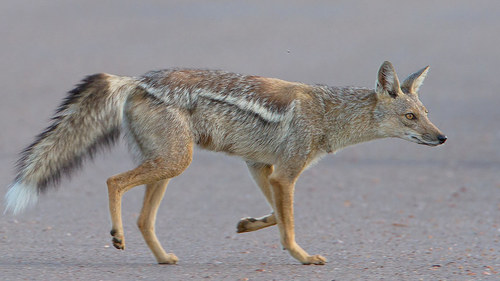
The least known and most discreet of the African jackals, the Side-striped Jackal is an elusive canid. It prefers dense undergrowth to the open spaces where its relatives are more easily seen.
Its name comes from a faint pale stripe along each flank, a much more subtle feature than the striking "saddle" of the Black-backed Jackal, with which it is often confused.
It lives in pairs for years. Its diet includes an unusually high proportion of fruit for a canid, even contributing to seed dispersal for several species of African trees.
A small to medium-sized canid with uniform brownish-grey fur, a faint pale stripe along each flank bordered by a faint dark line, and an always white tail tip. It differs from the Black-backed Jackal by lacking the mottled black saddle on its back, and from the Golden Jackal by its lateral stripe and white tail tip instead of a dark one.
Track similar to that of a small fox, 4-5.5 cm long, with four toes and distinct claws. Droppings are elongated and somewhat twisted, 5-8 cm long, containing abundant remains of fruit and insects. They are deposited scattered under dense vegetation cover, which the Side-striped Jackal prefers over open areas.
The Side-striped Jackal is much less vocal than other African jackals, with a shorter, higher-pitched howl that is rarely heard. This makes it harder to detect by sound than its relatives.
Miombo woodland, wooded savanna, and dense scrub. The Side-striped Jackal shows a clear preference for areas with more vegetation cover than other African jackals, avoiding very open spaces. It is distributed across a wide band of central, eastern, and southern Africa, from the Sahel to South Africa, but is absent from the most arid areas of the continent's southwest.
Omnivore with a notably high proportion of fruit in its diet, complemented by small vertebrates, insects and carrion.
The Side-striped Jackal forms monogamous pairs that defend a stable home range. Young from previous litters sometimes collaborate in rearing subsequent ones. Compared to other jackals, it has discreet habits and is less vocal. It spends the day hidden in dense vegetation, emerging to feed mainly at night.
It maintains large and stable populations in most of its African home range, with no signs of widespread decline.
Habitat loss in forest and wooded savanna due to agricultural expansion, and control due to occasional conflict with livestock farming, with no significant global threats.
See all species accounts for carnivores · Full species index
Mammaling is a free app for logging the mammals you find. You record a sighting in a moment — even if it's just a track — your life list grows, and the record becomes available to scientific and conservation projects.
It runs on your phone with nothing to install. If you like, it adds to your home screen like any other app.
Open Mammaling